





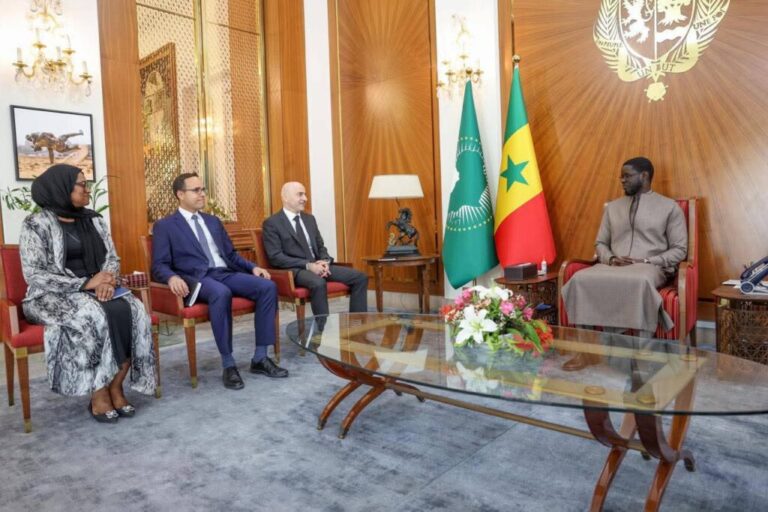
A mission from the International Monetary Fund (IMF) visited Dakar from August 19 to 26, 2025, to discuss a new program of economic reforms with the Senegalese government.
The discussions followed the recent revelation of a severe debt situation, which has prompted the government to launch an ambitious recovery plan.
The IMF team, led by Edward Gemayel, examined the fiscal discrepancies found in a Court of Auditors’ report published in February. The report revealed that central government debt, initially reported as 74.4% of GDP at the end of 2023, was actually 111%. Due to undisclosed liabilities, this figure climbed to 118.8% by the end of 2024.
In a statement, Edward Gemayel praised the government’s “commitment to fiscal transparency and accountability.” The discussions focused on structural reforms, including: Centralizing debt management, strengthening the National Public Debt Committee, auditing payment arrears, and creating a centralized database for financial data.
The IMF mission coincided with the government’s presentation of its Economic and Social Recovery Plan, which aims to correct what Prime Minister Ousmane Sonko called a “catastrophic economic legacy.” The plan, which is the first step of the nation’s Vision 2050, is built on a budget deficit estimated at 14% of GDP.
The recovery plan relies 90% on domestic resources, with a goal of raising an estimated 5,667 billion CFA francs between 2025 and 2028. This will come from sources like additional tax revenue, asset recycling, and new financing not tied to debt. The plan also includes institutional reforms, improved governance, and new revenue from taxes on digital, green, and blue economies.
The IMF has expressed its readiness to support Senegal in designing a new reform program centered on budget transparency, revitalizing key sectors, social equity, and climate resilience.
Despite the fiscal challenges, Senegal’s economy grew by 12.1% in the first quarter of 2025, largely driven by the new Sangomar and GTA oil and gas fields. However, growth in other sectors remains modest at 3.1%. Inflation remains low at 0.7%.
AC/Sf/fss/abj/APA