





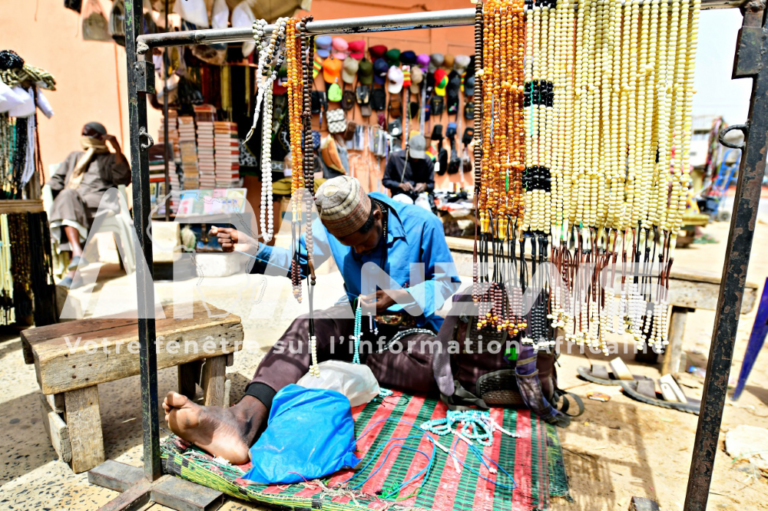
Unwavering devotion, fewer customers: in Dakar, vendors of religious items are navigating a Ramadan tightrope marked by economic slowdown, even as the spiritual value of prayer beads remains untouched by the crisis.
At Tilène Market in the Senegalese capital, prayer beads sellers are experiencing subdued trading during the Ramadan. While religious fervor remains strong, economic pressures are weighing heavily on sales.
On Monday morning, daylight is only beginning to spill over the rooftops of Medina. Stalls are set up in near silence. Vendors arrange their goods with deliberate movements, but customers are slow to arrive. Ramadan has begun, yet the usual crowds are missing. Those selling religious items wait patiently — a patience that seems to mirror the rhythm of the holy month itself.
“A prayer bead strand is not just an object; it’s a companion in worship,” says Abou Sow, who has run his stall here for several years. “During Ramadan, everyone seeks to increase their good deeds. The beads help keep count.”
His business, however, has been forced to adapt to the new downturn. Like many traders at Tilène Market, he has had to relocate within the area following redevelopment works linked to the upcoming 2026 Summer Youth Olympics, which have reshaped Avenue Blaise Diagne. No one has left Medina, but each vendor has had to find a new spot.
A few meters away, Mamadou Niang carefully arranges his merchandise. His selection ranges from 500 CFA francs (about $0.90) for standard models to 100,000 CFA francs (around $180) for high-end pieces crafted from precious woods, amber or semi-precious stones. The variety is broad, but buyers are scarce.
“Before, business was good,” he says with a sigh. “This year, the economic situation is holding people back” he laments.
For some customers, however, choosing prayer beads goes beyond a simple purchase. Anna Guèye selects a model priced at 25,000 CFA francs (approximately $45) and holds it in her hands as if it was her own even before paying for it.
“When I’m facing difficulties, I take it, I perfume it, and I recite my prayers. Each time, God answers me,” she says. For her, the object carries a value far greater than its price tag.
That spiritual dimension underpins a very real seasonal trade. In Senegal, the sale of prayer beads and religious items intensifies in the lead-up to Ramadan. From Dakar’s markets to the streets of Saint-Louis and Thiès, hundreds of small vendors rely on these few weeks for the bulk of their annual income, at the crossroads of faith, local craftsmanship and imports from Asia and the Arab world.
At Tilène Market, amid colorful stalls and the scent of incense, prayer beads circulate less as ordinary merchandise than as symbolic objects — linking devotion and daily life, tradition and the economics of survival.
AC/sf/lb/as/APA