



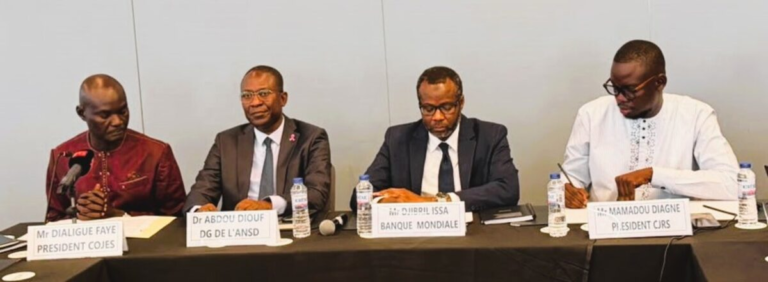
Journalists in Dakar participated in a specialized training session focused on analyzing and interpreting statistical data, an initiative organized jointly by Senegal’s National Agency for Statistics and Demography (ANSD) and the World Bank Group.
The workshop, titled From Data to Information, brought together members of the Senegalese Economic Journalists’ Association (COJES) and the Convention of Young Reporters of Senegal (CJRS) to address growing concerns regarding the accuracy and reliability of figures circulating in public discussions.
During the event, ANSD Director-General Abdou Diouf introduced a proposed legislative reform designed to extend the country’s statistical clearance mechanism. Under the proposed law, statistical outputs that enter public debate—beyond standard official statistics—could be subject to statistical verification to prevent misinterpretation, confusion, and the spread of unverified information.
Highlighting the importance of reliable data, Djibrilla Issa, the World Bank’s division director for Cabo Verde, The Gambia, Guinea-Bissau, Mauritania, and Senegal, emphasized that consistent statistical production is critical for sound decision-making. He stressed that media professionals play a key role in breaking down complex data, explaining public policies, and informing citizens about ongoing development initiatives.
Media representatives underscored the urgency of building data literacy as public institutions release increasingly large volumes of information. CJRS President Mamadou Diagne noted the growing need for journalists to master statistical analysis, while COJES President Dialigué Faye called for enhanced capabilities in reporting on complex topics like economic growth, public finances, and employment trends. Faye remarked that modern reporting requires accessing, interpreting, and intelligently presenting data, adding that investing in data reporting skills directly raises the quality of public debate across Senegal.
SS/te/Sf/lb/abj/APA