





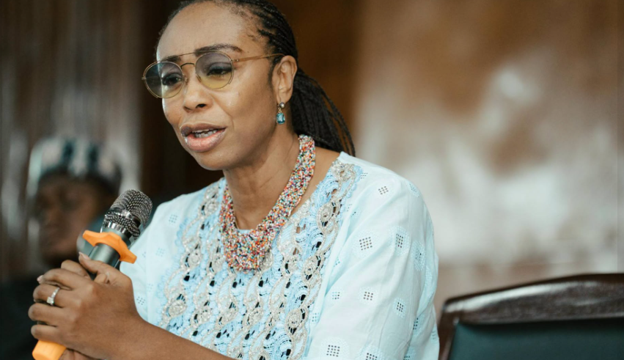
Speaking at the Weekly Press Conference organized by the Ministry of Information and Civic Education at the Miatta Civic Centre, Executive Secretary of the Independent Commission for Peace and National Cohesion (ICPNC), Hawa Sally Samai addressed the vital topic of “The ECOWAS Summit and the Implications for Peace and National Cohesion.”
Hosted by the Minister of Information and Civic Education, Chernor Bah, the event gathered media representatives and key stakeholders to discuss governance, peace, and national development. Madam Samai noted that recent domestic political developments present a prime opportunity to deepen reconciliation and mend relationships between political actors and citizens alike.
Reflecting on the initial reactions to recent political engagements, Madam Samai acknowledged the public concerns regarding the involvement of individuals tied to Sierra Leone’s conflict history. However, she urged that the immediate priority must remain the full implementation of agreed-upon political frameworks.
She highlighted that rebuilding relationships across Sierra Leone’s social, political, and economic landscapes—particularly between the Presidency, former political leaders, and the leadership of both the All People’s Congress (APC) and the Sierra Leone People’s Party (SLPP)—is a massive step forward. “The question now is: what happens next? Peacebuilding requires continuous engagement beyond the signing of agreements. The most important thing is that we move beyond words and ensure that actions follow.”
To ensure these words translate into reality, the ICPNC has already begun actively engaging political actors and stakeholders. The Commission is working to understand their interpretations of the agreements and to assess their willingness to drive the process forward. Rather than imposing top-down solutions, the Commission’s mandate is to facilitate constructive spaces where citizens and institutions can openly address the issues affecting national cohesion.
Madam Samai emphasized that maintaining national peace is a collective responsibility, requiring active contribution from political parties, civil society organizations, local communities, security institutions, and everyday citizens. Pointing to the devastating lessons of Sierra Leone’s past civil war, she described peace as a continuous journey that demands patience, compromise, and mutual respect.
A critical part of this journey involves looking back at the country’s historical roadmaps. Madam Samai referenced the findings of the Truth and Reconciliation Commission (TRC), revealing that approximately 61 percent of the TRC’s recommendations remain outstanding. These unaddressed areas cover essential aspects of social conditions, governance, reconciliation, and national healing that still require urgent attention.
ABJ/APA