



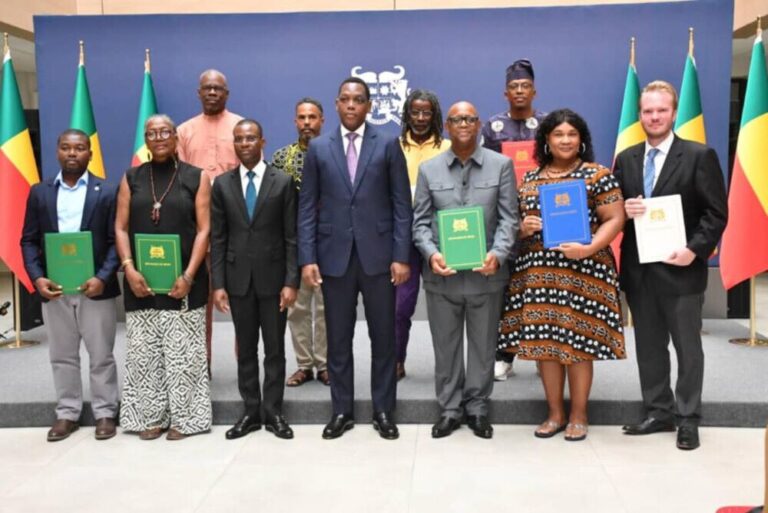
Ten people of African descent officially reconnected with their Beninese roots by receiving their nationality certificates at a ceremony held on Saturday, at the Cotonou Judicial Complex.
The ceremony took place in the presence of the Minister of Justice and Legislation, Yvon Detchenou, and the Secretary General of the Ministry of Foreign Affairs, Franck Armel Afoukou. The initiative was led by the Nationality Issuing Authority, which operates under the Ministry of Justice and Legislation.
Through this process, the ten recipients formalised their connection to the land of their ancestors, whose forebears were forcibly removed from Africa during the transatlantic slave trade.
For the Beninese authorities, these certificates have implications beyond their purely administrative and legal significance.
They represent a symbol of reconnection with African history, memory, and identity, while also allowing the recipients to strengthen their ties with Benin.
“I am truly proud to be Beninese,” declared Lavaury Gutemberg Theodore, an Afro-descendant originally from Guadeloupe and living in France.
He welcomed a process that, in his view, allows him to reconnect with his roots and pay homage to his ancestors.
After more than 40 years abroad, the recipient described obtaining this nationality as “a powerful act,” believing it represents an entire family history and shared memories.
Francelise Kiavue, also originally from Guadeloupe, expressed similar emotion, welcoming this recognition as “a great victory.”
She explained that she grew up hearing the stories of her ancestors, passed down in particular by her father.
“Their great-great-grandchildren have returned.” “And so it’s a victory,” she declared, expressing her gratitude to the Beninese authorities for this opportunity for a symbolic return to the African
land of her ancestors.
Through this ceremony, Benin intends to make nationality an instrument for bringing Africa and its Afro-descendant diaspora closer together.
The initiative also carries a message of remembrance and transmission, inviting descendants of the diaspora to reconnect with their origins and contribute to building new ties with the continent.
For the authorities, this reconnection is not about erasing the wounds of the past, but about allowing Afro-descendants to inscribe their history within a new dynamic, based on identity, memory, and the building of a shared future.
TE/fss/as/APA