





The Trade Union Congress has threatened to call a nationwide strike within two weeks if the Federal government of Nigeria fails to scrap the proposed 5 per cent tax on petroleum products.
The Organised Private Sector (OPS) has also rejected the move by the government to introduce a five per cent surcharge on fuel, stressing that it would worsen inflation nationwide if implemented.
The announcement by the Trade Union Congress came after days of speculation that the surcharge could take effect in January 2026. The rumour quickly set off public anxiety in a country where changes in fuel pricing often trigger unrest. President Bola Tinubu’s tax committee pushed back, saying no start date has been set and stressing that only the finance minister has the authority to decide when, or if, the measure would be implemented.
The five per cent tax on petroleum products is part of the government’s broader fiscal reforms aimed at boosting revenue. However, Africa’s biggest oil producer is already battered by the removal of fuel subsidy, rising inflation and the devaluation of currency.
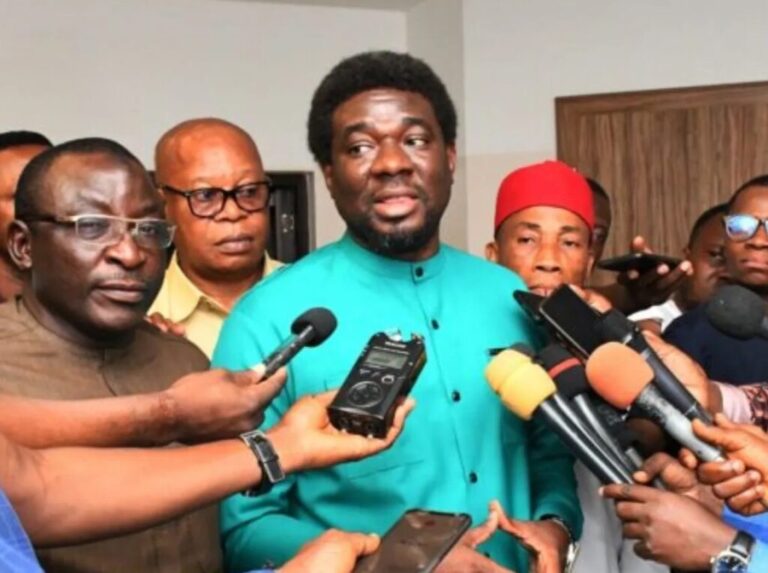
“The proposal is economic wickedness that would compound the struggles of ordinary Nigerians,” TUC President-General Festus Osifo and Secretary-General N.A. Toro said.
“The government cannot continue to use Nigerians as sacrificial lambs for its economic experiments. Instead of offering relief, jobs and solutions, it has chosen to further squeeze citizens dry. This is unacceptable,” the union leaders added.
The TUC warned that it had begun mobilising its affiliates, state councils and allied groups, including civil society organisations, professional associations, student unions, market leaders and faith-based groups, for “total nationwide resistance” if the government pressed ahead with the levy.
The union warned that strike action was firmly on the table if the government failed to heed its warning, saying Nigerians deserved economic justice rather than “endless punishment. The levy, when implemented, will apply to fossil fuels such as petrol and diesel but exclude cleaner alternatives like cooking gas, compressed natural gas, kerosene and other renewable energy sources.
“Enough is enough,” the union statement said. “Nigerians deserve economic justice, not endless punishment.” The tax provision is not new. It was first introduced under the Federal Roads Maintenance Agency Act of 2002, which created FERMA as a statutory body responsible for monitoring and maintaining federal roads.
A 2007 amendment to the Act provided a funding mechanism through a five per cent user charge on petrol and diesel sales, with 40 per cent of proceeds allocated to FERMA and 60 per cent directed to State Roads Maintenance Agencies.
The members of the organised private sector are averse to the proposal of a five per cent tax on petroleum products. They worry that any additional tax, regardless of how small the percentage, will spike inflation and worsen the living conditions of Nigerians.
The Lagos Chamber of Commerce and Industry President, Gabriel Idahosa, noted that the five per cent tax, which is to be exacted at the point of sale of petrol and diesel, will be passed on to consumers who may reduce their consumption. The worst effects will be felt in the transportation sector.
Idahosa said, “If the tax is going to be on the pump price, it means that the cost is already passed to the consumer. What it also means, of course, is that the current reduction in consumption of those products will be further aggravated, because many people presently use their cars minimally, and proceeding with the tax will put a lot more pressure on the public transportation system.”
The LCCI president predicted a slight but additional hardship from the policy, as more people rely on the public transportation system, especially workers. It is unclear how the spread and the enforcement of the tax will be.
In addition, the President of the Association of Small Business Owners of Nigeria, Dr Femi Egbesola, decried the five per cent tax on petrol products, citing overtaxation and inadequate social safety nets.
“We are paying a lot of taxes, both directly and indirectly,” Egbesola said. “Poverty is increasing by the day. It is concerning when a country does not have enough social safety nets and inflation keeps hitting the people; the government find ways to squeeze the little money out of their pocket through taxation and other levies.”
Egbesola argued that the Federal Government should introduce more tax relief rather than imposing new taxes. He lamented that “businesses are closing down by the day” and urged the government to be more concerned about the wealth of the people rather than adding to their burden.
GIK/APA