





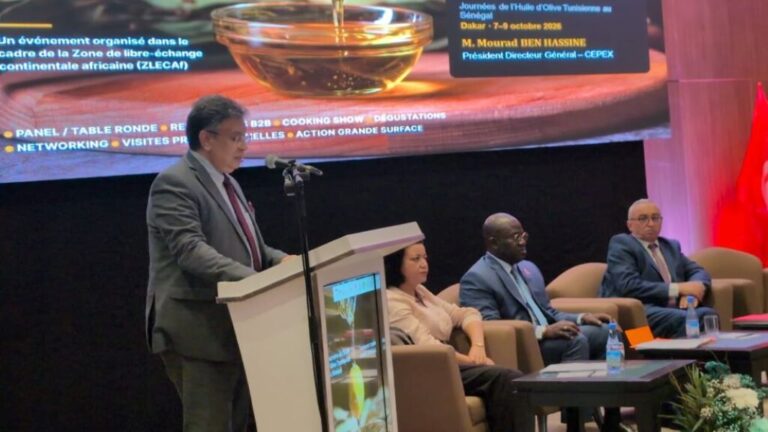
Tunisia seeks to strengthen its presence in the Senegalese olive oil market and use the country as a springboard to expand trade with West Africa, leveraging an economic event held in Dakar from October 7 to 9.
This economic event, dedicated to promoting Tunisian olive oil, was organised by the Tunisian Ministry of Trade and Export Development and the Export Promotion Centre (CEPEX), with support from the Tunisian Embassy in Dakar and GIZ Tunisia, as part of the “Support for the African Continental Free Trade Area (AfCFTA)” programme.”
Beyond promoting a flagship product of Tunisian agriculture, the organisers primarily seek to identify business opportunities in the Senegalese market and foster sustainable partnerships between companies from both countries.
Speaking on behalf of the Senegalese business community, Mohamed Seck, Vice-President of the National Council of Employers of Senegal (CNP), emphasised Senegal’s strategic position for Tunisian companies looking to access the West African market.
“Senegal serves as a key gateway to West Africa,” he stated, noting that economic relations between the two countries should now move beyond simple trade.
According to him, Tunisia possesses industrial and agrifood expertise and know-how that could find numerous market opportunities in Senegal.
“We must gradually shift from simple trade to investment, know-how transfer, the creation of joint ventures, and regional market development,” he added. Focusing on partnerships
For the Senegalese business leader, Tunisian olive oil is a high-quality product, but the key challenge lies in the ability of operators in both countries to build sustainable economic
relationships.
This cooperation could specifically encompass distribution, the development of commercial networks, packaging, the agrifood sector, and the creation of business partnerships.
The Senegalese market can thus serve as a testing ground for a stronger Tunisian presence in West Africa, while Senegalese companies can also benefit from Tunisian expertise in the agrifood sector.
“The Senegalese business community naturally supports this type of initiative, as we are convinced that the development of our economies will also depend on stronger cooperation between our private enterprises,” emphasizsed Mohamed Seck.
Tunisia highlights its olive sector potential
CEPEX Director General Mourad Belhassi presented the performance of Tunisia’s olive sector and the country’s ambitions in international markets, with a particular focus on Africa.
He noted that olive growing is a strategic sector for the Tunisian economy, with over two million hectares dedicated to olive trees and a total stock estimated at around 147 million trees.
Tunisia is one of the world’s leading players in the olive oil industry and is now seeking to further diversify the geographic reach of its exports.
According to data presented at the meeting, Tunisian olive oil exports saw a sharp increase during the 2025-2026 season, with over 380,000 tonnes exported between November 2025 and August
2026.
The value of these exports reached nearly 5 billion Tunisian dinars – approximately €1.4 billion – according to figures released during the meeting.
A significant portion of these exports consists of extra virgin olive oil, while Tunisian authorities also aim to accelerate the move upmarket and the development of packaged products.
Dakar at the heart of the African strategy
Tunisia’s drive to strengthen its presence in Senegal relies notably on the CEPEX office in Dakar, which has been operational since 2023.
This office is designed to facilitate connections between Tunisian and Senegalese companies and support business operators as they expand into the local market.
For the initiative’s proponents, proximity to the market is a crucial factor in understanding consumer expectations, identifying distribution channels, and developing tailored product offerings.
The Dakar meeting aims to enable Tunisian companies to gain a better understanding of the Senegalese market and establish contacts with importers, distributors, and other local economic players.
Senegal as a gateway to West Africa
However, the stated ambition extends beyond the Senegalese market alone. Senegal’s geographic and economic position makes it a potential gateway to West African markets, particularly in the context of implementating the AfCFTA.
This perspective lends a regional dimension to Tunisia’s approach and paves the way for projects combining exports, distribution, investment, and industrial partnerships.
For Mohamed Seck, the primary goal of these meetings is to achieve concrete results.
“Many contacts, many contracts, and concrete partnerships,” he said, wishing the Tunisian partners “very, very, very good business.”
The Dakar meeting is expected to mark a new step in strengthening economic ties between Senegal and Tunisia, with olive oil serving as a flagship product for broader commercial cooperation.
TE/fss/as/APA