





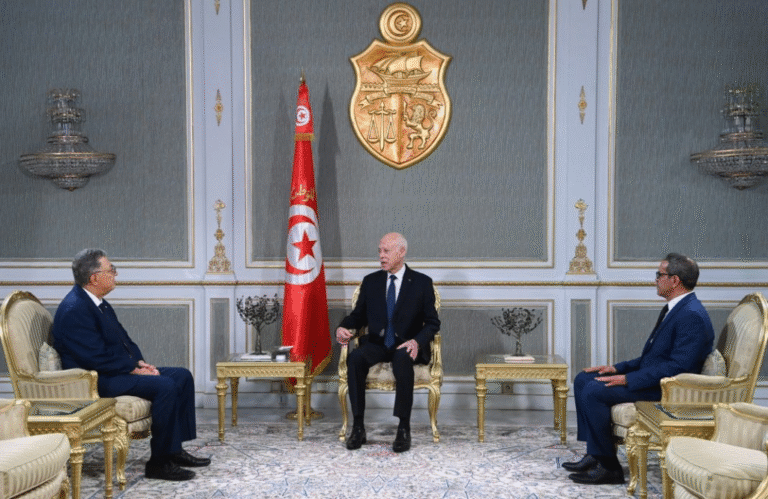
Tunisian President Kais Saied met with the heads of Parliament and the National Council of Regions and Districts on Monday, doubling down on his “self-reliance” policy and a call for “national liberation.”
While the President stressed that the country’s institutions reflect the exclusive will of the Tunisian people and warned against foreign interference, his sovereignist rhetoric was not accompanied by any concrete measures to tackle the nation’s severe economic crisis.
During the meeting, held at the Carthage Palace with Ibrahim Bouderbala and Imed Derbali, President Saied affirmed his commitment to fighting the exclusion and marginalization that affects large segments of the population. He presented his “self-reliance” stance as the necessary alternative to international partnerships he considers restrictive, denouncing domestic actors who are allegedly “in the pay of colonialist circles.”
However, this strong defense of national sovereignty comes as Tunisia grapples with serious economic pressures, including an unemployment rate exceeding 15%, inflation over 7%, and high external debt that severely limits the government’s fiscal options.
Furthermore, Tunisia’s crucial negotiations with the IMF have been stalled for months, highlighting the country’s financial impasse. For many observers, the President’s repeated criticism of international partners risks deepening Tunis’s diplomatic isolation. His defensive rhetoric is seen by critics as masking a fundamental lack of structural economic reforms needed to halt the deterioration of Tunisians’ living standards.
MK/ac/fss/abj/APA