





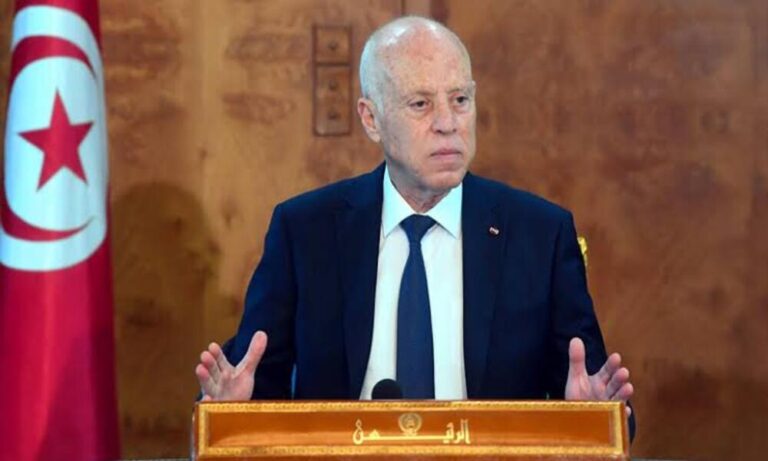
Tunisian President Kais Saied has renewed his criticism of red tape and vested interest groups, which he claims are obstructing progress in the country’s agricultural sector.
In a statement on Monday, the presidency said Saied condemned the spread of “procedures lacking a legal basis,” citing administrative circulars that demand outdated documentation – some as old as 10 years – and impose tax payments without lawful justification.
It said Saied called for the immediate removal of bureaucratic barriers obstructing farmers and rural producers during a meeting on 6 November at the Carthage Palace with Interior Minister Khaled Nouri and Finance Minister Michket Slama Khaldi.
The president warned that such practices “stifle small producers” and contribute to growing public mistrust in government institutions.
Adopting a sharply critical tone, Saied accused what he described as “pockets of counter-revolution” and entrenched “lobbies” of deliberately eroding public trust in state institutions.
He called on authorities at all levels to “fully assume their responsibilities” and to protect farmers from “speculators and hoarders.”
The head of state also denounced “certain mercenary voices” accused of manipulating public opinion under the guise of administrative obedience.
According to him, the government’s policy aims to “support small farmers at every stage of production, storage and sale.”
He reaffirmed that “Tunisia remains a state governed by the rule of law” and that immediate measures would be taken to “put an end to these abuses.”
Observers, however, say this is a recurring rhetoric from the president who continues to point to internal enemies to justify his increased control over institutions. They see no real structural reform on the horizon.
Delivered just months ahead of pivotal national elections, the remarks appear to form part of a broader populist strategy aimed at redirecting political focus toward rural development and agrarian reform.
Since consolidating all power in his hands in 2021, Saied has made numerous announcements without providing the agricultural sector, a pillar of the Tunisian economy, with any tangible investment or modernisation programmes.
MK/AK/fss/jn/APA