



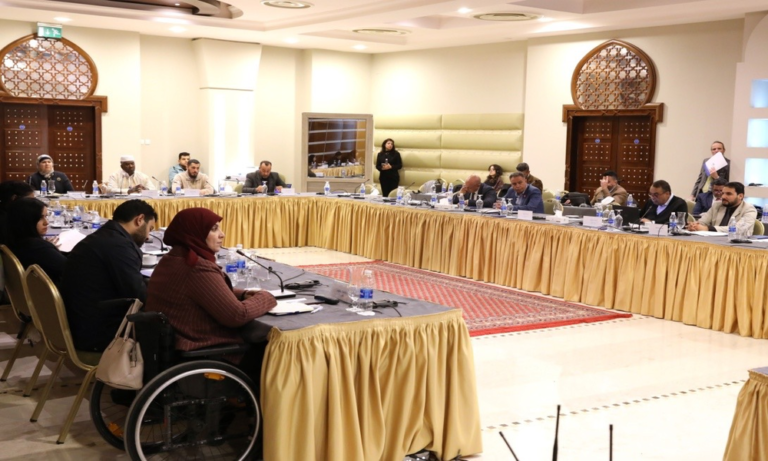
A United Nations-backed round of talks concluded after five days of discussions in Libya, yielding no decisive breakthrough but reaffirming the ambition to end the institutional deadlock paralysing the country’s electoral process.
A governance-focused track, conducted under the auspices of the United Nations Support Mission in Libya (UNSMIL), brought to a close five days of talks held as part of the so-called “structured dialogue” aimed at steering Libya out of its prolonged electoral impasse.
Talks had focused primarily on the persistent obstacles to organising national elections, notably the lack of consensus on a legal framework and the stalemate surrounding the finalisation of the board of the High National Elections Commission, according to a statement issued by the UN mission.
Participants examined several practical options and formulated recommendations intended to inform the next stages of the process. These conclusions are expected to be presented to the United Nations Security Council by the UN Special Representative for Libya, Hanna Tetteh, who is due to brief members on a dialogue described as “Libyan-led and Libyan-owned.” A recurring phrase in UN communications, it nonetheless struggles to conceal the decisive role played by international mediation and arbitration.
According to Hanna Tetteh, the objective of the talks was to enable Libyan stakeholders to produce concrete recommendations for the country’s political future. Deliberations focused in particular on existing electoral laws, notably those drafted by the controversial so-called “6+6” committee, as well as proposals put forward by a consultative committee.
Emphasis was placed on understanding the safeguards and concerns underpinning these texts, in the hope of narrowing deeply entrenched political divisions.
The final day of talks featured a meeting between participants, the UN Special Representative and members of the Berlin Process Political Working Group. Key recommendations were presented, followed by exchanges with international diplomats who reiterated their support for a UN-facilitated roadmap. The carefully worded formula reflects the limits of a process in which external support remains indispensable in the absence of a solid internal compromise.
The UN has stressed that the structured dialogue is not intended to appoint a new government, but rather to create the necessary conditions for credible elections and to address related challenges in governance, the economy and security. Talks are expected to resume in March, though no clear timeline for resolving the crisis has been set.
In a country where dialogue initiatives have multiplied for years without delivering tangible electoral outcomes, this latest round illustrates both the persistence of international engagement and its limited effectiveness.
In the absence of a clear and binding political agreement among Libyan actors themselves, the talks risk being added to a long list of consultative processes, without guaranteeing that the electoral deadlock will finally be broken.
MK/ak/sf/lb/as/APA