





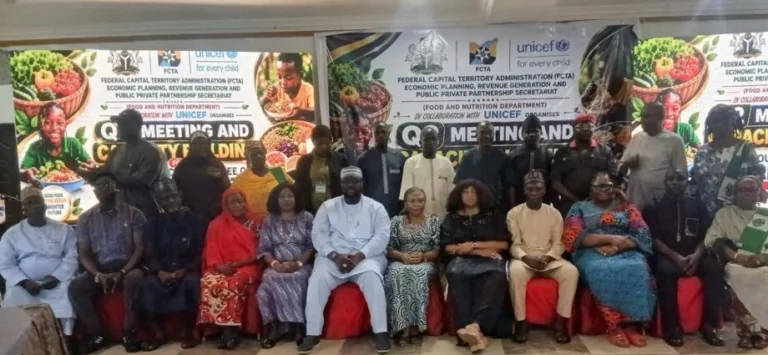
Nigeria’s Federal Capital Territory Administration (FCTA) and UNICEF, have called on the leadership of the six area councils of Abuja to take full ownership of local food and nutrition programmes to curb malnutrition and boost food security.
The Mandate Secretary, Economic Planning, Revenue Generation, and Public-Private Partnership (EPRGPPP) Secretariat, FCTA, Mr. Ubokutom Nyah, said at the Area Council Committee on Food and Nutrition’s 2nd Quarter Meeting and Capacity Building that nutrition security was a “cornerstone of human capital development and economic growth”.
Mr. Nya, who was represented at the event in Abuja on Monday, by the acting Permanent Secretary at the secretariat, Mr. Uba Bala, emphasised that policy success relies heavily on grassroots execution across local wards and households.
While acknowledging UNICEF’s financial and technical support, Nyah noted that a healthy population serves as the true driver of economic prosperity and sustainable growth.
“While overarching strategic frameworks originate at the Secretariat level, their ultimate success depends entirely on the impact made in local wards, villages, and households,” he said.
He charged the area council leadership and specialised nutrition focal officers to take firm ownership of local initiatives, streamline inter-sectoral coordination, and ensure that vital resources directly reach the territory’s most vulnerable populations.
In her remarks at the event, the Director of Food and Nutrition Department, EPRGPPP, Princess Gaza-Oluwafemi, explained that the capacity-building was designed to deepen participants’ understanding of core nutrition concepts and current local malnutrition burden.
Gaza-Oluwafemi added that the workshop would also enlighten participants of high-priority nutrition interventions and the critical first 1,000 days of life.
She noted that the programme focused on sharpening operational skills in monitoring, evaluation, reporting, multisectoral coordination, the Child Nutrition Fund match mechanism, and the formulation of actionable, localised work plans.
The director urged all attendees to translate their newly acquired theoretical knowledge into direct action within their respective jurisdictions, emphasising that local officers sit on the front lines of community-based health interventions.
Dr. Chizoba Steve-Edemba, representing the UNICEF-US Department of State Maternal and Child Health Umbrella Grant, commended the joint effort and reiterated that local committees are best positioned to drive meaningful change.
Steve-Edemba emphasised that the interactive training would clearly delineate individual roles within the broader governance structure, equipping leaders with the precise tools necessary to manage and sustain high-impact food programmes in their communities.
Responding, the Vice Chairmen from all six area councils pledged to prioritise the implementation of nutrition policies.
Local media reports stated that Aid Diversion Committees for each of the area councils were inaugurated at the event to guarantee transparency and accountability in resource management.
GIK/APA