



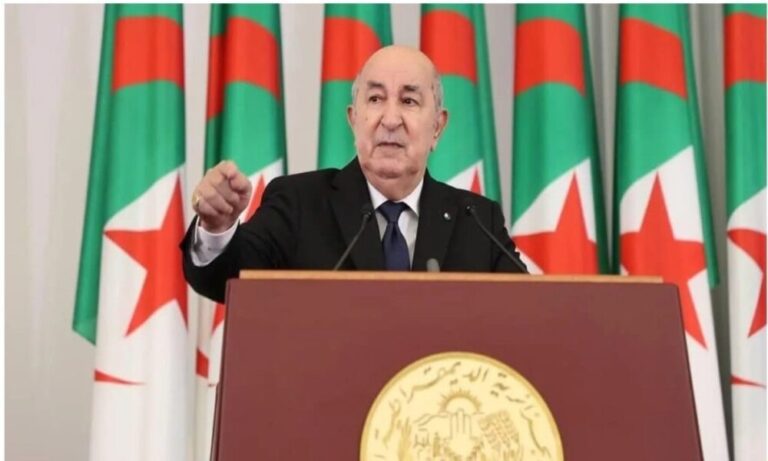
President Abdelmadjid Tebboune has defended a “technical” amendment to the Constitution while firmly ruling out any prospect of a third term, in remarks that have nonetheless failed to dispel lingering doubts over the country’s institutional trajectory.
Speaking during his regular interview with the national media, broadcast on Saturday on state television and radio, Tebboune sought to clarify the authorities’ intentions regarding a planned constitutional revision.
Presented as a purely technical adjustment, the reform is said, according to the president, to aim at consolidating “the construction of a genuine democracy” and addressing implementation difficulties identified since the adoption of the 2020 Constitution.
The Head of State stressed the non-political — even administrative — nature of the proposed amendment, arguing that it is designed to strengthen Algeria’s institutional foundations by remedying shortcomings that have emerged in practice, particularly in the functioning of certain bodies.
This official narrative appears intended to pre-empt broader interpretations of a constitutional overhaul which, in Algeria’s recent history, has often been associated with shifts in executive power.
It is precisely on this point that Tebboune adopted a firm tone. Responding to speculation linking the constitutional revision to a possible challenge to presidential term limits, he “unequivocally” dismissed any scenario involving a third term.
The President also denounced what he described as “destabilization manoeuvres” orchestrated by external actors, whom he accused of exploiting the constitutional debate to weaken the country.
Such rhetoric, now familiar, tends to discredit domestic concerns by attributing them to foreign interference.
On substance, Tebboune nevertheless acknowledged that the 2020 Constitution is not without flaws. He pointed in particular to
difficulties surrounding the partial renewal of the Council of the
Nation, a mechanism that has proved complex to implement.
The proposed amendment would therefore seek to remove these obstacles without altering the overall structure of the constitutional text.
Tebboune maintained that there is “nothing fundamentally wrong” with the 2020 Constitution, which he described as faithful to the principles of the 1 November 1954 Declaration and open to civil society.
In parallel, the president announced preparations for an amendment to the law on political parties, presented as a response to demands from the national political class.
Described as a major “democratic milestone”, the reform is intended to strengthen pluralism and establish a more structured and lasting dialogue between the authorities and political parties. Once again, the emphasis was placed on a shared societal project rather than a short-term political adjustment. Scepticism, however, remains.
Against a backdrop of low voter turnout, a fragmented opposition and institutions largely dominated by the executive, the announcement of a constitutional revision — even one labelled as technical — has reignited questions over the true balance of power.
Is the verbal rejection of a third term sufficient to dispel doubts, or does it amount primarily to a communication exercise aimed at containing persistent mistrust? Ultimately, it is through actions ather than assurances that this reform will be judged.
MK/AK/lb/gik/APA