



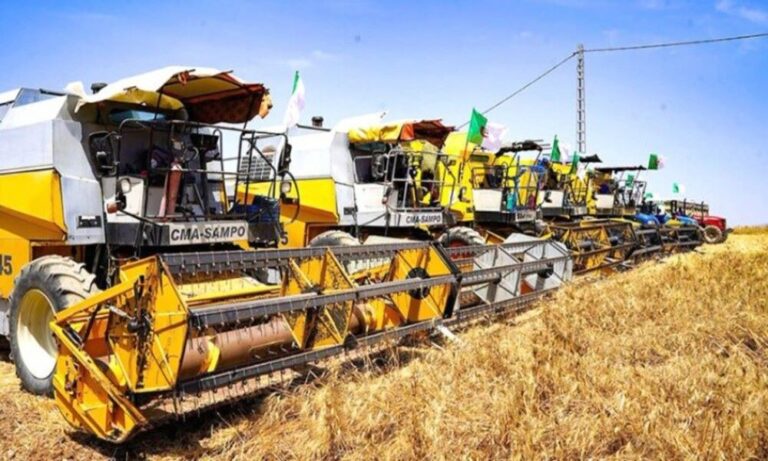
Algerian authorities are presenting the 2026 grain season as a “historic” turning point, with over 2.4 million tonnes of durum wheat expected.
However, this announcement still largely relies on projections and is insufficient to erase the structural weaknesses of the country’s agriculture.
Barley production is projected to surpass 900,000 tonnes, according to estimates circulating around the 2026 harvest season.
These volumes are presented as sufficient to cover national needs in both categories, to the point of suggesting “historic” self-sufficiency since independence.
However, this assertion deserves to be qualified. Firstly, because these are forecasts, and the harvest is not yet fully finalised.
Secondly, because the self-sufficiency mentioned specifically concerns durum wheat and in no way implies that Algeria has resolved the much broader issue of its cereal dependence, particularly for other types of wheat.
The triumphalist rhetoric also masks a paradox: the announced performance is largely attributed to the significant rainfall recorded this season.
However, this persistent dependence on rainfall precisely underscores the vulnerability of the agricultural model.
The return of good harvests in the West and the High Plateaus comes after several years of drought that severely impacted yields. A poor harvest could therefore quickly reverse this trend.
Another sign of the sector’s persistent limitations: the anticipated abundance is already, according to reports, putting significant pressure on storage infrastructure.
The government has had to reinforce collection centres, develop local silos, and deploy more combine harvesters. The scale of this deployment demonstrates that producing more does not automatically solve the problems of
collection, storage, and processing.
Claims regarding the exceptional “quality” of the harvest remain difficult to assess in the absence, at this stage, of detailed data on average yields, areas actually harvested, or final volumes collected.
The 2026 harvest could therefore represent a significant improvement for Algerian agriculture. However, presenting Algeria now as being on the verge of sustainable food sovereignty is more a matter of ambitious political narrative than a definitively established structural reality.
A single good harvest, greatly aided by rain, is not enough to demonstrate the lasting transformation of an
agricultural system.
MK/AK/Sf/fss/as/APA