



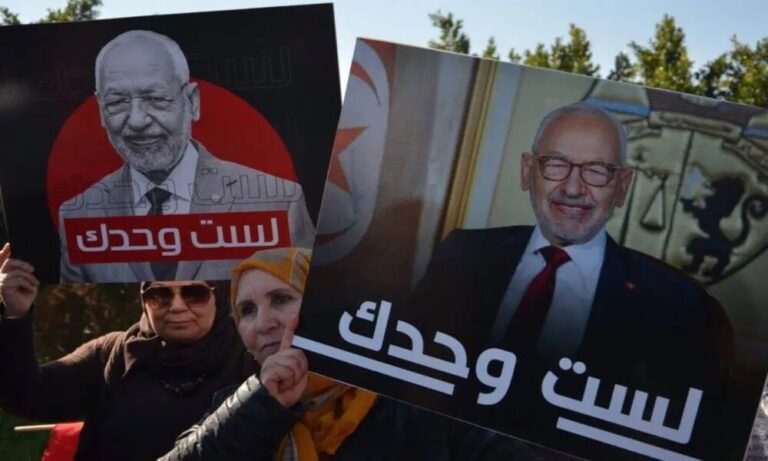
Last week’s protests in Tunis, which brought together several thousand protesters, expose the limitations of Kais Saied’s rule – a regime now facing dissent fuelled by a rejection of repression, high unemployment, and the deterioration of public services.
On Saturday, October 17, several thousand Tunisians marched along Avenue Habib Bourguiba in Tunis to denounce the concentration of power in the hands of President Kais Saied, the imprisonment of political opponents, and the worsening of living conditions.
Trade unionists, lawyers, doctors, journalists, civil society activists, and representatives from various political persuasions converged in what was one of the largest demonstrations against the regime in several years.
This mobilisation highlights the widening gap between the president’s promises of national recovery and an increasingly concerning social reality.
Years after the authoritarian turn that began on July 25, 2021, the Tunisian leadership has struggled to justify the outcomes of an institutional overhaul initiated in the name of overcoming political
paralysis.
The suspension of Parliament, the consolidation of executive power, and the gradual dismantling of checks and balances have failed to provide a lasting solution to unemployment, regional inequalities, or the weakening of public services.
effectively become a permanent political system, all while the hardships that fuelled popular anger remain unaddressed.Social indicators underscore this impasse. According to figures cited in an analysis by Tunisian sociologist Tesnim Ghannouchi, the unemployment rate reached 14.9% in the second quarter of 2026, with the figure rising to 35.4% among young people aged 15 to 24. It stood at 26.6% among higher education graduates, and at 35.6% among female graduates.
persistence of economic and social crises.Political repression forms the other front of this dissent. Several opposition figures, hailing from various ideological backgrounds, have been imprisoned or handed heavy sentences. Rached Ghannouchi – a former parliamentary speaker and a prominent figure in the Ennahdha movement, who has been in custody since April 2023 – was sentenced to life imprisonment in June 2026, according to the source text.In an opinion issued in 2025, the United Nations Working Group on Arbitrary Detention concluded that his detention was arbitrary and called for his release. The legal proceedings targeting opposition figures, journalists, and activists are shrinking the space for public debate, creating a risk that any form of dissent will escalate into a direct confrontation with the authorities.
With the fifteenth anniversary of the first free elections – held on October 23, 2011 – just days away, the protest reveals a convergence between social demands and the defence of civil liberties.
While it does not yet outline a unified political alternative, it does weaken the presidential narrative: a vision of power acting on behalf of “the people,” while dismissing any dissenting voices as illegitimate.
MK/AK/fss/as/APA