



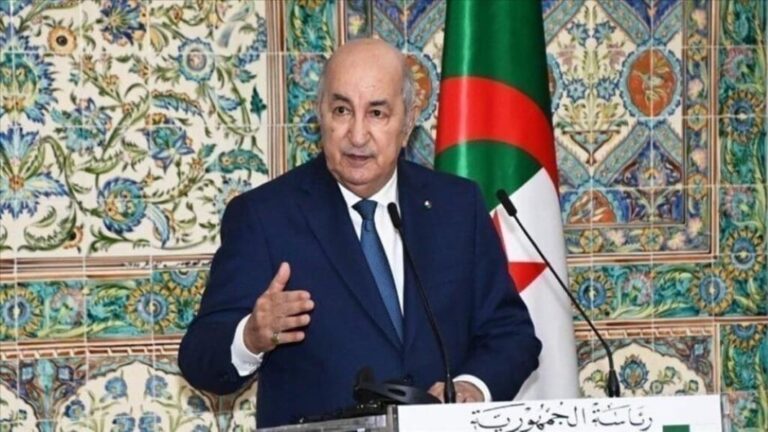
President Abdelmadjid Tebboune’s meeting with Louisa Hanoune, like the ones that preceded it, reflects a long-standing constant in Algerian political life: reforms are presented as inclusive, yet crafted behind closed doors.
Parties are invited, seldom heard. Pluralism is invoked, never applied.
In a now familiar political ritual, Tebboune received the secretary-general of the Workers’ Party as part of what the authorities describe as a broad cycle of “national consultations.” Officially, the initiative is meant to foster open dialogue with political forces. Unofficially, it resembles a carefully staged performance designed to project the illusion of active pluralism while real decision-making remains tightly centralised, controlled and politically sanitised.
Hanoune thus joins the long line of carefully selected figures whom the authorities have consulted throughout 2025. Personalities labelled as “opposition” — but only within the limits tolerated by the system: defeated presidential candidates, leaders of authorised parties, a handful of vetted critical voices. Nothing that might disrupt the façade of openness the regime is intent on maintaining.
These consultations appear all the more formulaic as the major reforms announced — the law on political parties, the electoral law, and the communal and wilaya codes — already seem fully framed at the highest levels of the state. The scenario is predictable: presidential announcements, a tightly managed administrative process, then automatic approval by a compliant Parliament.
Political adviser Mustapha Saïdj is coordinating the “technical meetings” with political parties, supposed to feed into the draft legislation. Several parties say their proposals were “well received.” But in Algeria, inclusion follows an unchanging script: authorities listen, reassure, then legislate without deviating from the presidential line.
In practice, party participation serves mainly to provide procedural legitimacy to reforms that have already been written, and to offer the authorities the appearance of a national dialogue that does not truly exist.
After her meeting, Louisa Hanoune described a “frank” exchange addressing the new wilayas as well as economic, social and international issues. A constructive, almost optimistic message highlighting efforts to “improve living conditions” and “correct shortcomings.”
Such talking points fit neatly within the framework set by the authorities: a critical yet compliant opposition that voices concerns without ever questioning the nature of the system, the vertical concentration of power or the absence of checks and balances. An opposition confined to an unofficial consultative role in a system that accepts pluralism only when it is supervised, predictable and devoid of political impact.
MK/te/lb/as/APA