





The Algerian state is reviving one of its flagship industrial projects, at the cost of a political mobilisation that betrays both the scale of its ambitions and the structural weaknesses of the economic model it is pursuing.
Meeting in the Council of Ministers, the Algerian executive reviewed the progress of the mining railway project linking Blad El Hadba to Oued El Kebrit and the port of Annaba, as well as the construction of a mining quay dedicated to phosphate exports.
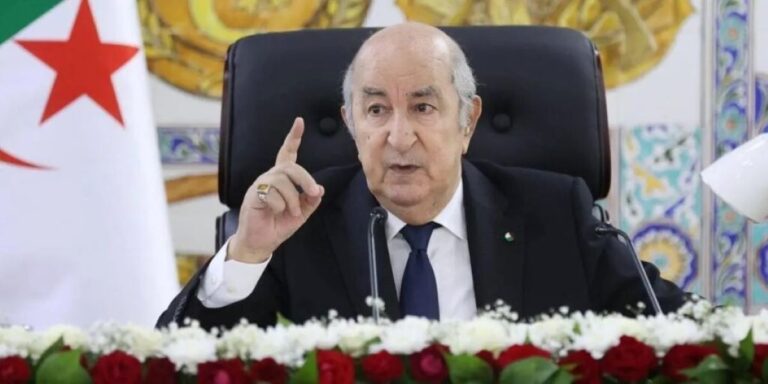
Following this meeting, President Abdelmadjid Tebboune ordered a significant acceleration of the project, accompanied by a tight schedule and enhanced monitoring.
Behind the presidential directive, the officially stated objective is to transform Algerian phosphate into a sustainable engine of growth and exports. The head of state reiterated the “strategic” nature of this megaproject, presented as a structuring investment intended to diversify an economy still heavily dependent on hydrocarbons.
But this proactive rhetoric barely conceals the fact that this long-announced project is struggling to maintain the pace of execution promised, to the point of now requiring direct presidential oversight.
The instructions given to the Minister of Public Works reveal this tension. A monthly report is now required, with a target completion date of the end of 2026 and commissioning announced for the first quarter of 2027.
President Tebboune also called for strengthened coordination between the relevant ministries and the foreign partner, while demanding that the pace of construction be “doubled” and that all administrative obstacles be removed.
This increased centralisation of project management underscores the limitations of an executive branch often criticized for its slowness, bureaucratic inefficiencies, and lack of operational autonomy.
The Annaba mining terminal, presented as the centerpiece of the phosphate export system, further illustrates this logic of perpetual urgency.
Conceived as a lever to increase export volumes and support a national fertilizer industry, it is part of a broader economic transformation strategy.
However, the lack of detailed public data on expected profitability, the project’s actual costs, and its competitiveness against major global producers’ fuels doubts about its capacity to generate genuine added value for the Algerian economy in the short and medium term.
On the ground, the authorities highlight technical advances concerning basic infrastructure, notably the gas connection, the electricity supply, and the doubling of the railway line linking the deposit to the port of Annaba.
These advances, regularly showcased in official communications, nevertheless remain contingent on lengthy delays and complex coordination between public actors, within a constrained budgetary context.
Finally, the project’s internationalization, formalised by the signing of a memorandum of understanding between
Somiphos and the Indonesian group Pupuk, aims to lend credibility to the ambition of an integrated phosphate industry. But here again, the announcements of partnerships contrast sharply with an industrial reality that is still embryonic.
By multiplying commitments and directives, the Algerian government seeks to demonstrate a desire to break with the past. It remains to be seen whether this top-down acceleration will be enough to transform a symbolic megaproject into a genuine economic pillar, or whether it will simply postpone, once again, the test of concrete results.
MK/AK/Sf/fss/as/APA