





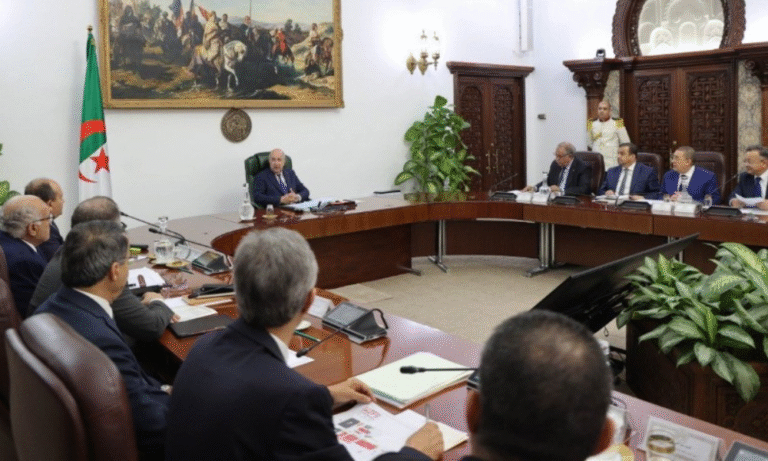
Algerian President Abdelmadjid Tebboune is positioning the country as a leader in Africa’s economic integration, but this vision is facing questions about its true motivations.
Just days before the opening of the Intra-African Trade Fair (IATF 2025), President Tebboune spoke about the need to boost intra-African trade, which currently accounts for only a fraction of global trade.
The IATF, which is expected to generate $40 billion in trade, is being presented as a key moment for the African Continental Free Trade Area (AfCFTA). However, Algeria’s bold claims contrast sharply with its own economic reality. The country’s economy is heavily dependent on hydrocarbons, which undermines its credibility as a continental leader.
President Tebboune often talks about the emergence of a “powerful Africa” and has even promised $1 billion through Algeria’s International Cooperation Agency, along with canceling the debts of some poor countries. But critics say these announcements are more about improving Algeria’s image than creating real economic change, as they often lack transparency.
The government’s actions are often ambiguous. For example, Algeria presents its state-owned companies, Sonatrach and Sonelgaz, as partners in African development, even though they primarily pursue Algeria’s own energy interests. The government also promotes “know-how transfer” by training African executives, but this doesn’t hide the country’s own internal problems, like high youth unemployment.
By pushing for symbols like a “G4 Africa” and speaking out against neocolonialism, President Tebboune is trying to project an image of continental leadership. However, Algeria continues to struggle to diversify its trade and integrate into African value chains. Many observers believe Algeria’s economic diplomacy is more about improving its international standing than genuinely responding to Africa’s needs.
MK/Sf/fss/abj/APA