





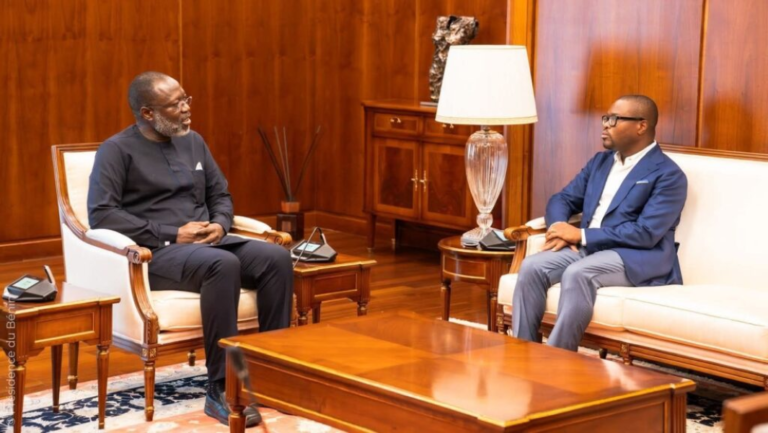
Beninese President Romuald Wadagni reaffirmed his country’s commitment to ECOWAS while calling for a rapprochement with the Alliance of Sahel States (AES), against a backdrop of persistent regional tensions.
President Romuald Wadagni extended an olive branch to the countries of the Alliance of Sahel States (AES), in a context marked by diplomatic tensions between Cotonou and Niamey, Niger.
The day after his inauguration, the new Beninese head of state received ECOWAS Commission President Omar Alieu Touray for talks focused on regional stability, economic integration and security challenges in West Africa.
ECOWAS had backed Beninese authorities during the attempted coup of December 2025 under the presidency of Patrice Talon, activating its regional crisis management mechanism and mobilising its standby force to protect constitutional order in Benin.
The meeting comes after President Wadagni used his inauguration address to call for a resumption of dialogue between ECOWAS member states and the AES countries — Mali, Burkina Faso and Niger — which attended the ceremony through high-level delegations.
“In a subregion confronted with the terrorist threat, we are compelled to work together,” the Beninese president declared, advocating for cooperation grounded in “stability, dialogue and respect.”
The Malian delegation was led by Foreign Affairs Minister Abdoulaye Diop, that of Burkina Faso by Karamoko Jean-Marie Traoré, while Niger was represented by Prime Minister Ali Mahaman Lamine Zeine.
The Beninese head of state pledged “Benin’s readiness to act in concert” with neighbouring countries in the fight against terrorism and in relaunching closer regional cooperation.
Wadagni’s remarks represent a diplomatic shift after several months of friction between Benin and Niger, triggered by the July 2023 coup in Niamey that ousted President Mohamed Bazoum.
Nigerien authorities had accused Cotonou of hosting foreign military bases intended to destabilise Niger — accusations rejected by Benin. The prolonged closure of the border between the two countries had also affected economic exchanges, notably the transit of Nigerien oil through the port of Cotonou.
By reviving the call for dialogue with Sahelian states while reaffirming Benin’s attachment to ECOWAS, Romuald Wadagni appears to be repositioning his country as a bridge between the West African grouping and the AES regimes.
“Together, we can build a powerful Africa by making our own strategic choices,” he argued.
AC/Sf/lb/as/APA