





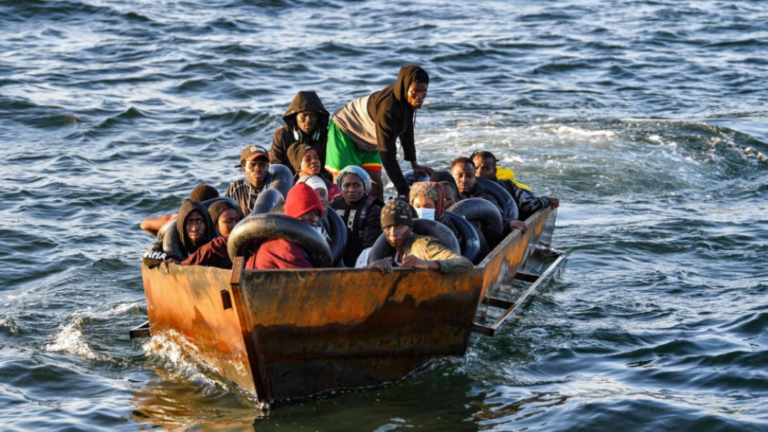
Nearly a month at sea, an overcrowded pirogue, and a death toll exceeding 80: the crossing to the Canary Islands has turned into a tragedy for dozens of migrants who set out from The Gambia, according to a platform.
More than 80 people, including an infant, died aboard a pirogue that left The Gambia and was rescued south of the Canary Islands after 26 to 27 days adrift at sea, the On the Trail of the Migrant (SLTM) platform reported on Thursday.
According to the platform, 128 people boarded the vessel at the beginning of August. Only 45 passengers survived the crossing, while five bodies were still on board at the time of the rescue.
The dugout canoe was spotted Wednesday afternoon by a surveillance aircraft approximately 120 kilometres south of Gran Canaria. The rescue vessel Guardamar Urania intervened Wednesday night to assist the survivors.
Due to rough seas, rescuers were unable to recover the five bodies on board, which remained on the vessel. The 45 survivors, including 44 men and one woman according to initial reports, were evacuated to the dock in Arguineguín, in the municipality of Mogán, where they were taken in charge by the relevant authorities and the Red Cross.
SLTM reports that the Guardia Civil confirmed to the Spanish NGO Caminando Fronteras that the markings found on the hull corresponded to a pirogue that had departed from The Gambia in early August with 128 people on board, including four women and an infant.
The survivors also told Red Cross teams, upon their arrival in Arguineguín, that they had set off for the Canary Islands in a group of over one hundred and that several passengers had died during the crossing.
The “On the Trail of the Migrant” platform is continuing its investigations to establish the identity and nationality of the victims and survivors, particularly to determine the possible presence
of Senegalese nationals among the passengers.
This latest tragedy highlights the extremely perilous conditions of the Atlantic crossings from the West African coast to the Canary Islands, characterised by long periods at sea and particularly
precarious vessels.
AC/Sf/fss/as/APA