



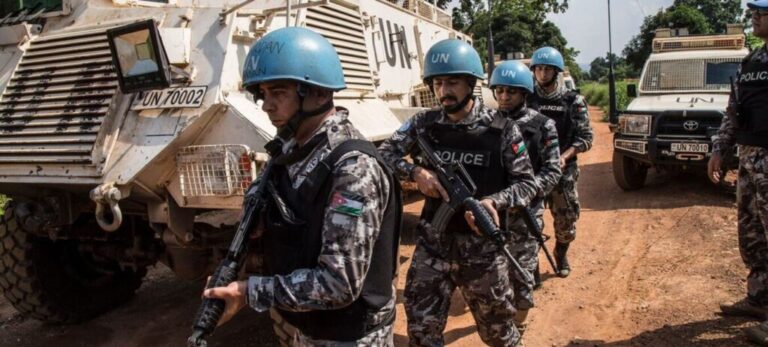
Peace remains fragile in the Central African Republic despite advances in disarming armed groups and reviving democratic processes, with reintegrating former combatants and confronting ongoing security pressures among the foremost hurdles ahead, outgoing UN Special Representative Valentine Rugwabiza warned.
Wrapping up four years at the helm of the UN Multidimensional Integrated Stabilization Mission in the Central African Republic (MINUSCA) ahead of the end of her mandate on November 30, 2026, Rugwabiza reviewed milestones achieved since April 2022 during her final press conference in Bangui. Remarking that the Central African Republic she is leaving at the close of November 2026 is not the country she encountered in April 2022, she emphasized that hard-won gains demand sustained follow-through from national authorities and international partners.
Among key security shifts, Rugwabiza pointed to the self-dissolution of 11 of the 14 armed factions that signed the Political Agreement for Peace and Reconciliation, alongside disarmament strides involving the Union for Peace in the Central African Republic (UPC) and the 3R. Since July 2025 through October 20, 2026, more than 1,900 combatants from those two movements had surrendered their weapons. Still, she cautioned that post-disarmament socioeconomic reintegration is vital to prevent ex-fighters from returning to violence, noting that the peace accord remains only partially implemented and that undissolved armed groups underscore how much work lies ahead. On the political track, she welcomed the staging of elections across all 85 sub-prefectures in 2025 and 2026—including the first municipal polls since 1988—as a milestone for decentralization, while urging authorities to equip local officials with adequate resources and ensure women’s meaningful representation in decision-making.
Those gains unfold against a volatile regional backdrop in which border zones remain exposed to spillover from neighboring conflicts, with Rugwabiza linking the attack at Am Dafock in the northeast to the war in Sudan. Amid budget pressures that have already forced the deferral of several infrastructure projects, MINUSCA is adjusting its posture to gradually transfer certain responsibilities to national institutions while operating under a Security Council mandate renewed through November 2027 focused on civilian protection, humanitarian support, and expanding state authority. With 10,290 troops deployed against an authorized ceiling of 12,000, the mission plans to emphasize rapid-response mobility in vulnerable areas while preserving capabilities matched to security threats.
Ahead of her departure, Rugwabiza appealed to Central African youth to rise above political divides and treat peace as a shared duty, while highlighting the media’s role in bridging divisions and reinforcing social cohesion. She also underscored a model of partnership grounded in respecting national priorities and reinforcing—rather than substituting for—state institutions, pointing to the community- and authority-backed rehabilitation of the Bria-Yalinga road. Her successor, Mohamed Ag Ayoya, is set to assume office on December 1, 2026, inheriting a peace process whose durability hinges on reintegrating former fighters, fortifying institutions, and stabilizing border areas.
TE/Sf/lb/abj/APA