





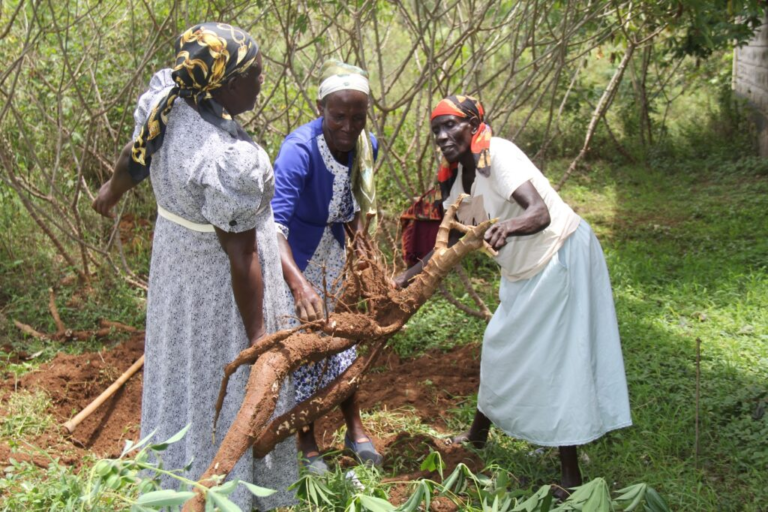
In western Kenya, climate change is disrupting harvests and access to water, adding to the burden of domestic work carried by older women who continue, despite mounting challenges, to feed and care for their grandchildren.
In the fields of Siaya County in western Kenya, the seasons no longer seem to follow familiar patterns. Too little rain and crops wither. Too much rain and harvests can be washed away. In between, older women continue to farm, fetch water and feed their families, often while raising their grandchildren.
A recent study involving 382 older women in the sub-counties of Alego Usonga, Bondo, Rarieda and Ugunja in Siaya, conducted to examine the link between climate change impacts and the caregiving responsibilities borne by these women, highlights the scale of the challenge.
The findings show that 90 percent are responsible for their grandchildren; more than half live with arthritis; one-third suffer from hypertension; and nearly one in five has diabetes.
During extreme weather events, 82 percent said they reduce their own food intake to preserve meals for their grandchildren, while nearly 60 percent reported receiving no climate-related information.
For these women, climate change is not simply about rising temperatures or extreme weather. It is measured in shrinking harvests, water that must be purchased and school fees that have become increasingly difficult to afford.
A central question has emerged: how do these older women continue caring for others when climate change makes every task more difficult?
“Climate change has really affected us, especially those of us who are elderly,” said Magdalena Amisi, a member of the Samba Widows women’s group in Bondo and a participant in the project.
During the dry season, she grows vegetables but lacks sufficient water for irrigation. She also has no irrigation equipment to help her. Harvests decline. Then comes the rainy season.
“It can also destroy the food and crops I have planted. As a result, there are many food shortages and I am unable to provide enough meals for my grandchildren,” she explained.
Magdalena has cared for her grandchildren since their parents died. She is now their sole caregiver.
“It is very difficult, especially during the dry season,” she said.
At her age, arthritis and other health problems further limit her physical capacity. She says she needs help with household tasks she can no longer perform on her own.
When harvests fail, another concern arises: how to pay school fees when most household needs are covered through crop sales, and how to ensure the children have enough to eat.
This is precisely where the “Climate and Care Nexus” — the link between climate change and caregiving at the heart of the Climate and Care Initiative — becomes particularly relevant.
The term “care” refers to activities, often invisible and unpaid, that involve caring for oneself and others: feeding children, looking after elderly or sick people, preparing meals, collecting water, supporting family members or simply ensuring their daily well-being.
In many communities, these responsibilities still fall largely on women.
In Siaya, this reality takes on a particularly human dimension: older women who must continue feeding, protecting and supporting their grandchildren even as the conditions required to do so become increasingly difficult.
When a poor harvest becomes a family crisis
In this rural region, located more than 400 kilometres northwest of Nairobi, several women tell different stories bound together by the same reality.
Seline Aduol, a member of the Uranga group in Alego Usonga sub-county, an area highly exposed to flooding, explained that when rainfall is excessive, crops can be destroyed, worsening food insecurity. When rains fail, the challenge takes another form: access to water becomes difficult.
“During droughts, access to water is also very difficult for us older women,” she said.
In her area, most household water comes from the Nzoia River, except during rainy periods when residents rely on harvested rainwater. Because she lives far from the river, she must pay someone to fetch water for her.
A 20-litre jerrycan costs her 30 Kenyan shillings, about US$0.23, when she hires someone to transport it to her home, and the price rises during drought periods. Water therefore becomes both a caregiving task and an additional expense.
These solutions may seem modest. But for these women, they can make the difference between complete dependence on outside assistance and the ability to produce at least part of the food consumed by the household.
For Seline, the change has been even more dramatic. Widowed since 2019, she is raising ten grandchildren alone. When she was younger, she said, the effort invested in farming was reflected in the harvest.
Dorine Awuor, a participant from Sihayi in Ugenya sub-county, said the challenge is not only knowing what to plant, but also who will work the land when she is no longer physically able to do so.
Hiring labour could solve part of the problem, but she cannot afford it. Her grandchildren, who could help, attend school from Monday to Saturday each week.
The same vicious cycle affects access to water.
“We may have a large farm, but we cannot produce enough because we no longer have the strength to cultivate it,” she said.
To cope, the three women have established kitchen gardens where they grow vegetables and onions, as well as cassava and sweet potatoes on parts of their main plots. The garden has become a small reserve of resilience.
They have also learned to make greater use of indigenous seed varieties, particularly maize varieties they consider better adapted to local conditions.
Cassava and potatoes provide useful alternative crops. But cassava takes time to mature, creating periods when maize supplies run low before cassava is ready for consumption. Nutritional quality is also a concern.
Producing more would require hired labour. Yet once again, financial resources are lacking. Climate change simultaneously reduces production, income and the physical capacity needed to offset losses.
And at the end of this chain, the people directly affected are those for whom these women care.
Learning to adapt rather than simply endure
This reality is precisely what the “Caring for Carers” project seeks to address. Implemented in Siaya County by the Muungano Rural Empowerment Centre under the Climate and Care Initiative, the programme aims to strengthen the resilience of older rural women facing the climate crisis while documenting the impact of climate change on their caregiving responsibilities.
The project includes community education activities, psychosocial support, advocacy work and knowledge production.
For participants, the effects are far from theoretical. They say they have learned new ways to cope with droughts and floods. Kitchen gardens have become one of the most visible solutions.
The use of indigenous seeds and diversification through cassava and sweet potatoes represent another response promoted by the project. Dorine said she has gained confidence in using local seed varieties, particularly for maize.
For these women, adaptation sometimes begins just a few metres from their front door.
New knowledge, but immense obstacles remain
The project has improved their understanding of climate-related risks in their local environment. Magdalena said information sessions helped her better understand ways of adapting to the climate emergencies facing their community.
But learning to adapt does not eliminate structural constraints. The women remain elderly. Some live with arthritis. Access to water remains difficult. Financial resources are limited. And their family responsibilities remain unchanged.
“We need substantial financial support,” Seline pleaded.
Such assistance would help pay school fees for grandchildren and improve their nutrition. Even when they succeed in growing cassava or potatoes, they stress the nutritional limitations of those crops. At their age, they say, they need sufficiently rich and diverse diets.
Dorine believes the Inua Jamii programme, which provides a social protection allowance of 2,000 Kenyan shillings (about US$15) per month for older people, is inadequate and barely sufficient to purchase basic necessities.
The women are not only asking for more money. They are also calling for better-organised support.
One proposal is to establish village-level databases identifying older people, vulnerable women and orphans, along with their specific needs. Current assistance mechanisms do not always reach the most vulnerable and do not allow for sufficiently targeted support.
For an elderly woman suffering from arthritis, even walking a short distance to stand in a queue can be a significant obstacle.
“We do not have the strength to queue,” Seline said.
They therefore want local authorities, including administrative chiefs and community leaders, to identify older people so that aid can be delivered directly to them.
Among all their demands, one recurs repeatedly: water.
During the dry season, access becomes particularly difficult. They propose a simple solution: installing water tanks near homes to collect rainwater during the wet season and store it for the dry months.
“During the dry season, we face serious problems because we do not have easy access to water,” Magdalena said, calling for the installation of tanks to harvest rainwater during the rainy season.
That single request encapsulates the link between climate and care. Water is needed for drinking, cooking, farming and caring for others. When it becomes scarce, all of these dimensions of daily life are affected simultaneously.
The paradox is all the more striking given that Siaya lies on the shores of Lake Victoria, one of the world’s largest freshwater reserves, yet lacks the infrastructure needed to use it effectively for household or agricultural purposes.
Women caring for others while climate change weakens them
For Sonia, a researcher at the Centre for Inequality Studies at the University of the Witwatersrand, these testimonies reflect a broader trend observed across Climate and Care Initiative projects.
“Climate change is increasing care burdens,” she said.
Droughts, floods and heat stress do not only cause material damage. They also make it harder to carry out the daily activities required to feed, care for and protect family members.
And when public adaptation and social protection systems are inadequate, families step in to fill the gap.
Very often, “it is once again women who shoulder this additional burden,” she noted.
For Magdalena, Dorine and Seline, that burden cannot be reduced to a statistic. It is measured day after day in a jerrycan of water, an uncertain harvest and grandchildren who must be fed, no matter what.
ARD/ac/Sf/lb/as/APA