





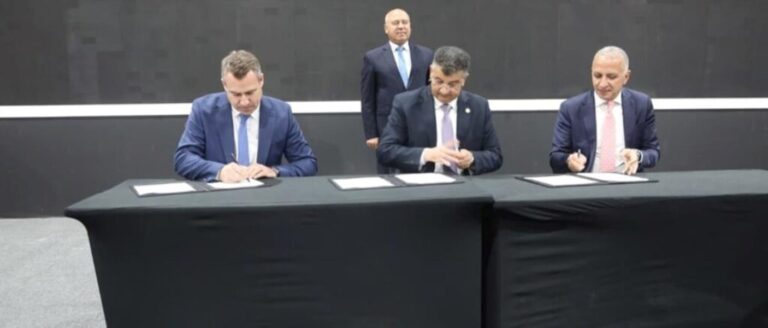
The National Tunnels Authority in Egypt has finalized a 15-year agreement with a major consortium to manage and operate the country’s new Ain Sokhna – Marsa Matrouh high-speed rail network.
The consortium is led by Deutsche Bahn International Operations (Germany) and El Sewedy Electric (Egypt). The agreement was signed on Thursday in the presence of Kamel Al-Wazir, Minister of Industry and Transport. The partners, including Tarek Gweily, Chairman of the National Tunnels Authority, Niko Warbanoff, CEO of Deutsche Bahn International Operations, and Ahmed El Sewedy, Chairman of El Sewedy Electric, formalized the deal.
The primary benefit of this agreement, according to the State Information Service, is the consolidation of the entire high-speed rail network under a single operator—the consortium—which will significantly “reduce the problems associated with multiple operators.”
The management model is structured as a revenue-sharing partnership. Crucially, the agreement emphasizes the transfer of expertise and mandates that Egyptian workers must comprise at least 95 percent of the total workforce.
To ensure sustainability and national capability, the agreement explicitly includes provisions for: Training and qualification of Egyptian engineers and technicians. Annual training in Germany for Egyptian train drivers on operating high-speed electric trains.
The ultimate goal is to enable Egyptians to eventually manage and operate the electric rail network independently.
Minister Al-Wazir highlighted the transformative role the new railway will play in the country’s development. He noted that the network is distinguished by its superior speed, comfort, greater transport capacity, and enhanced passenger safety compared to conventional trains.
Al-Wazir added that the project will significantly contribute to economic development, supporting both the industrial and tourism sectors.
By strengthening infrastructure in the areas it traverses, the rail line is expected to help create new urban communities and open up existing inhabited areas for development.
The National Tunnels Authority is currently operating three lines of the high-speed network, which span a total length of 2,000 km and cater to both passenger and freight transport.
AK/ac/fss/abj/APA