





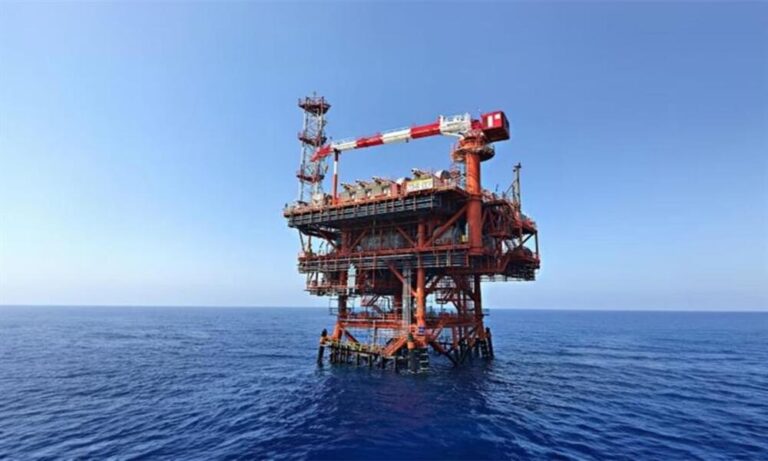
Sinai offshore oil fields have reached their highest daily production level since 2017, according to the Egyptian Ministry of Petroleum, which highlighted a more than 50% increase in production since the beginning of 2025.
The Egyptian Ministry of Petroleum and Mineral Resources announced on Sunday that the Sinai offshore oil fields region is now producing approximately 27,000 barrels of crude oil per day, a level not seen in nine years. This performance was recorded in an area operated by the Italian group Eni in partnership with the Egyptian General Petroleum Corporation (EGPC), according to an official statement.
Egyptian authorities attribute this increase to a vast investment program covering the Gulf of Suez, Sinai, and Nile Delta regions. The stated objective is to strengthen national hydrocarbon production by improving the value of existing assets and optimizing the exploitation of already operating fields. According to ministry data, production in the region has increased by more than 50% since January 2025, marking one of the highest growth rates observed in the area in several decades. This development is considered particularly noteworthy given that some of the fields in question have been in operation for over sixty years, a situation generally associated with a gradual decline in yields.
The ministry emphasizes that this increase has generated a surplus of more than 10,000 barrels per day, bringing the cumulative additional production to over 2.8 million barrels since the beginning of 2025. Authorities believe these results demonstrate the effectiveness of technical programs designed to extend the lifespan of mature oil fields. This momentum is supported by an intensive production optimization program that includes the deployment of new technologies, improved operational efficiency, and reduced downtime.
The resumption of drilling operations in 2026 also contributed to this growth. The ministry specifically cites wells BM-133 and 113-M-131, whose combined production exceeds 3,200 barrels per day, with associated water levels described as near zero. This performance has contributed to improving overall yields in the region. Ultimately, this increase in production is part of Egypt’s strategy to strengthen its energy security, as the country seeks to increase its domestic oil and gas supply to reduce its dependence on energy imports and support the development of its hydrocarbon sector.
MK/AK/Sf/fss/abj/APA