



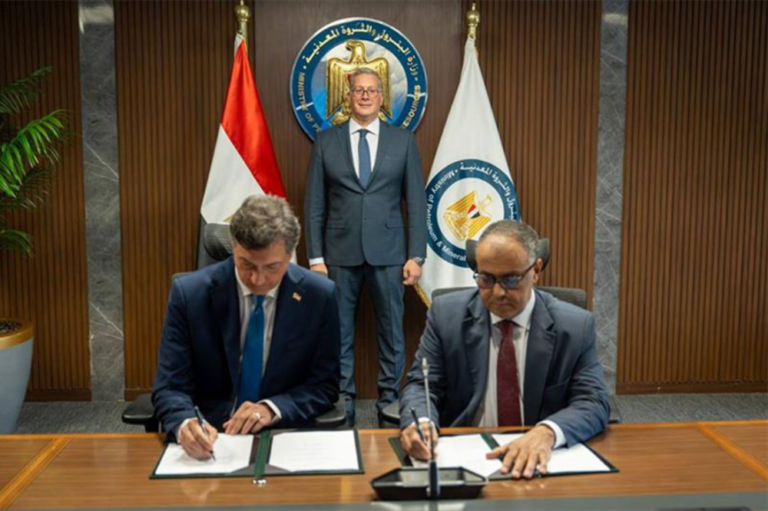
Cairo has signed two new agreements with Britain’s Harbour Energy and Italy’s Eni to accelerate gas exploration, develop new reserves, and strengthen the country’s energy security.
This comes just days after Egypt cleared all outstanding arrears owed to foreign oil companies.
Egypt is pressuring ahead with its offensive to revitalise its gas sector. The Egyptian Natural Gas Holding Company (EGAS) concluded the agreement with Harbour Energy, while the Egyptian General Petroleum Corporation (EGPC) has signed a memorandum of understanding (MoU) with Eni to renew the offshore Port Fouad development lease in the Mediterranean.
According to the cabinet, these initiatives align with the Ministry of Petroleum’s strategy to attract further investment and accelerate research, exploration, and development activities for gas resources.
For the Egyptian authorities, the stakes are twofold: halting the decline of mature fields and stimulating the discovery of new resources capable of sustaining national production. Minister of Petroleum and Mineral Resources Karim Badawi indicated that the agreements aim to bolster the security of energy supplies while supporting an increase in domestic production.
The first deal concerns the expansion of Harbour Energy’s activities in the onshore Nile Delta region of Dessouk. The project entails adding two new blocks to the existing concession and drilling two additional exploration wells. Maintenance operations are also scheduled for one of the wells currently in production. The initial investment is estimated at $6 million, supplemented by a $1 million signing bonus. In the event of new discoveries, total investments could reach approximately $18 million through additional funding earmarked for developing the identified fields.
This expansion builds on recent results achieved by the British company. According to the government, the Azz-1 and Azz-2 wells, drilled during the 2025–2026 fiscal year, added approximately 35 billion cubic feet of natural gas reserves. Harbour Energy also plans to push forward with its exploration campaigns, with three new wells scheduled for the 2026–2027 fiscal year.
The second agreement involves the renewal of the Port Fouad offshore development area, operated in the Mediterranean by Eni. The protocol aims to preserve the strategic area’s attractiveness while fostering favourable conditions for new capital inflows. It also guarantees the maintenance of existing infrastructure, considered essential for supporting current production and facilitating the exploitation of future discoveries in neighbouring zones.
Beyond their operational scope, these agreements carry significant symbolic weight. They come just days after the Egyptian government announced the full clearance of its debts to international oil companies. According to Minister Karim Badawi, this bill—which stood at $6.1 billion in June 2024 before being reduced to $1.3 billion in March 2026—is now officially resolved.
This financial normalisation substantially boosts the country’s credibility among energy investors.
By restoring trust with international partners and multiplying exploration incentives, Egypt seeks to consolidate its status as a regional gas hub in the Eastern Mediterranean, while securing its own energy needs amid growing domestic demand.
MK/AK/Sf/lb/as/APA