



The future of the Nile remains a particularly sensitive issue for Egypt, whose water supply depends almost entirely on the world’s longest river.
Alongside regional cooperation, this issue was at the heart of the talks between Egypt and Uganda held at Entebbe Palace.
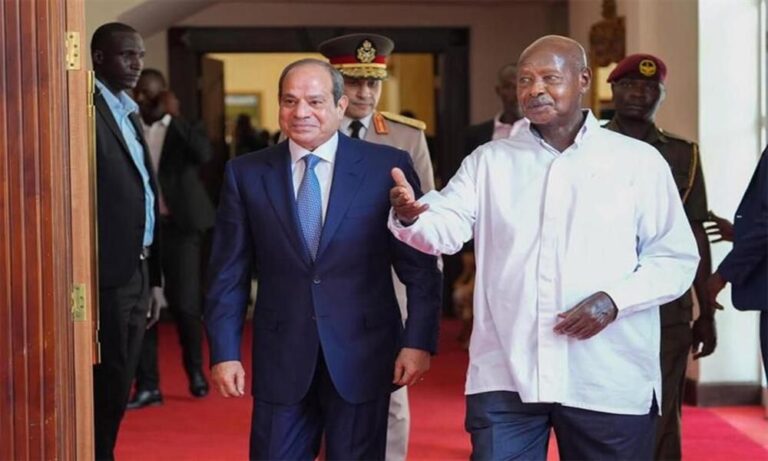
Egyptian President Abdel Fattah Al-Sisi and his Ugandan counterpart, Yoweri Museveni, emphasised coordination regarding the Nile and water resources during a meeting held Wednesday at the presidential palace in Entebbe.
This is against the backdrop of increasing African diplomatic initiatives focused on security, water, and regional integration.
The Egyptian presidency indicated that the two leaders discussed strengthening bilateral cooperation in several strategic sectors, including agriculture, irrigation, and health. Cairo seeks to
consolidate its relations with the Nile Basin countries, as water issues remain central to regional geopolitics.
This meeting follows President Al-Sisi’s participation in the Africa-France Summit held in Nairobi on May 11 and 12 under the slogan “Africa Forward.”
According to a statement from the Egyptian presidency, the head of state affirmed that “Egypt aspires to develop trade and establish sustainable investment partnerships that serve common interests.
Egypt’s water supply depends almost entirely on the river.
Cooperation with Kampala thus occupies an important place in Cairo’s diplomatic strategy toward East African states.
In this context, Al-Sisi officially invited Yoweri Museveni to the African Union coordination meeting scheduled to be held in Egypt in June 2026, while Uganda currently holds the rotating presidency of the East African Community.
Relations between the two countries have been characterized by sustained diplomatic activity for several months.
The Ugandan president’s last visit to Egypt was in August 2025, while Al-Sisi’s last visit to Uganda was in 2017.
The Egyptian president also congratulated his counterpart on his re-election, stating that it “reflects the confidence of the Ugandan people.”
Beyond bilateral issues, discussions focused on several regional crisis zones, notably in Sudan, Libya, and the occupied Palestinian territories. Al-Sisi emphasised the need for neighbouring countries to
play a “constructive role in restoring stability and establishing lasting peace.”
Museveni, for his part, advocated for “national and African” solutions tailored to the realities of the continent.
This diplomatic sequence is part of a broader regional offensive led by Cairo.
On the sidelines of the Nairobi summit, Al-Sisi had called for a reform of African debt management, urging a “break in the vicious cycle” of sovereign debt on the continent.
He had also held numerous meetings with several African leaders, UN Secretary-General Antonio Guterres, and the CEO of the CMA CGM group, Rodolphe Saade, regarding Egyptian port infrastructure.
MK/AK/Sf/fss/as/APA