



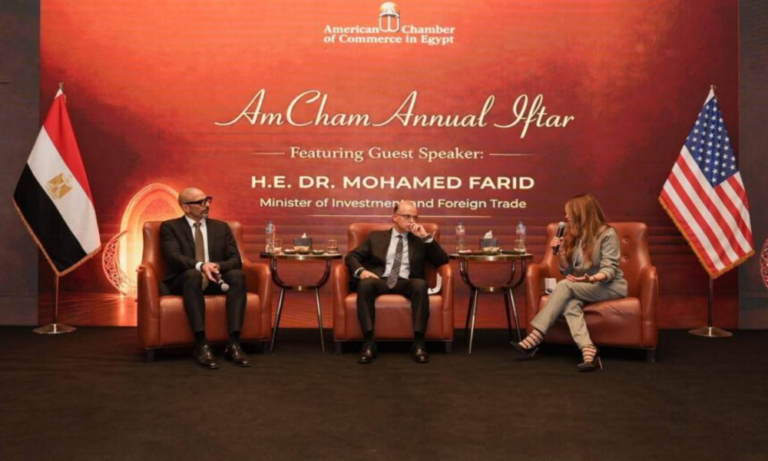
Egyptian Minister of Investment and Foreign Trade, Mohamed Farid, has unveiled a three-pronged strategy aimed at revitalizing the nation’s business environment and boosting international economic appeal.
Speaking during the American Chamber of Commerce’s annual iftar in Cairo, the minister described the current economic climate as a “pivotal moment” that demands deeper cooperation between the state and the private sector to restore investor confidence and foster sustainable growth.
The first pillar of this strategy focuses on the digital transformation of administrative processes. Minister Farid emphasized that reducing human intervention through digitalization is essential to creating a more transparent, predictable, and efficient environment for businesses. By streamlining these procedures, the government intends to lower the barriers to entry for both domestic and international investors.
The second priority involves a comprehensive improvement in the quality and accuracy of national economic data, specifically regarding investment and savings. Addressing the current economic gap, the minister noted that while Egypt targets a growth rate of 6% to 6.5%, this requires an investment rate of approximately 25% of GDP. With the current domestic savings rate hovering near 10%, Egypt must bridge this deficit through a mix of strategic foreign investment and disciplined borrowing.
The third priority addresses the regulatory landscape, with the government committing to reduce excessive state intervention in private economic decisions, such as mergers and acquisitions. By aligning its regulatory framework more closely with international standards, Egypt seeks to provide a more stable and competitive playing field for private enterprises.
Beyond these priorities, Minister Farid announced the creation of a new venture capital fund, developed in partnership with Egypt’s sovereign wealth fund, to support the local startup ecosystem. He underscored that the government’s primary focus remains the effective and consistent implementation of existing economic reforms. These steps represent a concerted effort to optimize Egypt’s market conditions and signal a long-term commitment to enhancing the country’s economic attractiveness on the global stage.
MK/AK/Sf/fss/abj/APA