



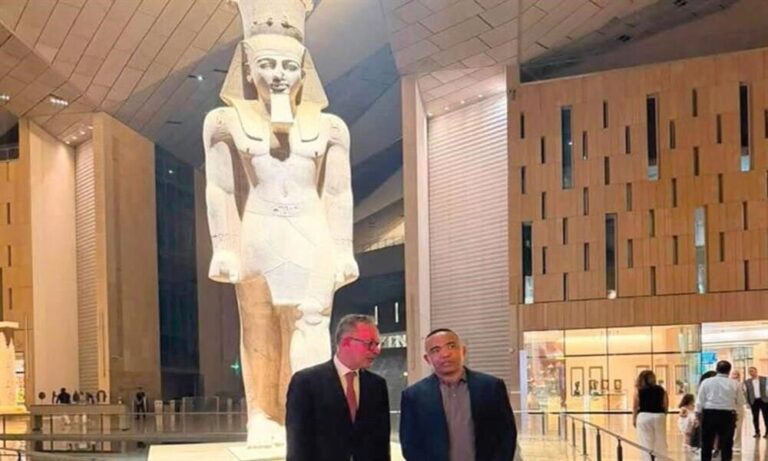
The Grand Egyptian Museum (GEM), at the foot of the Giza pyramids, has become a key stop for heads of state and high-ranking foreign officials visiting Egypt, combining official diplomacy with the promotion of pharaonic heritage.
This week, Malagasy President Michael Randrianirina visited the Grand Egyptian Museum, accompanied by an official delegation, during his trip to Egypt.
He was welcomed by Ahmed Ghoneim, Executive Director of the GEM Authority, before touring the museum’s main sections. The Malagasy head of state notably visited the main hall, the Grand Staircase, and the areas dedicated to the pharaonic collections, including the rooms of King Tutankhamun.
He also spent considerable time in front of the monumental statue of Ramses II, located in the museum’s hall and which has become one of the iconic pieces welcoming visitors.
Michael Randrianirina expressed his admiration for the statue’s dimensions, the precision of its sculpture, and the quality of the stone used.
At the end of his visit, he wrote a message in the museum’s guestbook, praising the institution and congratulating the Egyptian government and people for making this heritage accessible to the international public.
This visit comes just days after that of Stasa Kosarac, Deputy Prime Minister of Bosnia and Herzegovina and Minister of Foreign Trade and Economic Relations, who is also responsible for tourism.
Accompanied by the Egyptian Minister of Tourism and Antiquities, Sherif Fathy, the Bosnian official visited the Giza pyramid complex before touring the Grand Egyptian Museum.
These visits illustrate the growing importance of the Grand Egyptian Museum in the itineraries of foreign delegations visiting Cairo.
Beyond its cultural and touristic vocation, the establishment thus constitutes a heritage showcase used by Egypt to present to its international partners one of the major components of its historical heritage.
MK/Sf/fss/as/APA