



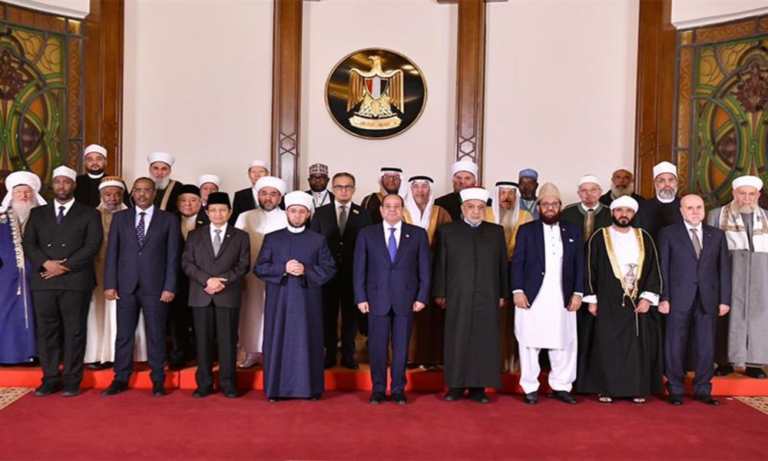
Egyptian President Abdel Fattah Al-Sisi on Monday in Cairo called for the preservaton of the “authentic and balanced” nature of religious messages, warning against any instrumentalisation of religion for purposes of confrontation, extremism, or violence.
During a meeting held at the presidential palace with delegations participating in the conference, organised on January 19 and 20 in the Egyptian capital, the head of state emphasised the need to protect religious discourse from attempts at ideological manipulation.
He stressed that some extremist interpretations aim to exploit religion to fuel terrorism and destabilise societies, calling for increased vigilance from religious institutions in the face of these abuses.
The discussions focused on promoting moderate thought and the role of religious discourse in combating extremism.
Participants emphasised the importance of strengthening the Islamic world’s position and fostering a genuine understanding of Islam.
They also acknowledged Egypt’s historical role and the prestige and influence of Al-Azhar in the Arab and Muslim world as a religious and intellectual authority.
Themed “Professions in Islam: Ethics, Impact, and Future in the Age of Artificial Intelligence,” the conference aims to examine the transformations brought about by new technologies and their moral, religious, and societal implications.
Several international delegations, including those from Saudi Arabia, Malaysia, Mongolia, Kyrgyzstan, and Russia, are participating, demonstrating the event’s international scope.
Abdel Fattah Al-Sisi emphasized that this conference represents a crucial link between Islamic values and the challenges of the digital future.
He affirmed that “Islam is a living religion, closely connected to reality and capable of interacting with the developments of its time,” including those related to artificial intelligence and the digital revolution.
The president reiterated that Egypt has made “human investment” a strategic pillar of its policy, aiming to cultivate a conscious and enlightened generation capable of addressing contemporary challenges.
He urged scholars and religious institutions to fully assume their responsibilities in the digital sphere, particularly on social media, to counter extremist rhetoric and promote messages focused on development, security, and the preservation of the nation.
The Egyptian leader also stressed the importance of their selection, training, and ongoing support, while also calling for the guarantee of decent living conditions.
He argued that mosques should play an integrated role – religious, educational and social – in the service of social cohesion.
MK/Sf/fss/as/APA