



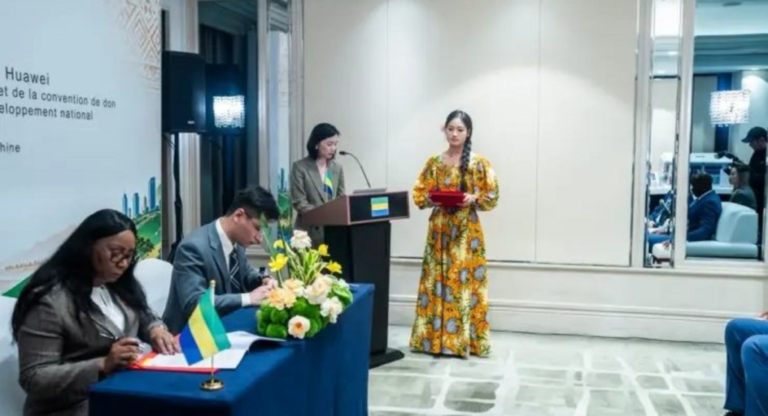
Gabon and China are strengthening their cooperation in infrastructure, energy, and new technologies through a series of agreements signed on Thursday in Shanghai.
The signing took place in the presence of Gabonese Head of State, Brice Clotaire Oligui Nguema, who is currently on a state visit to the People’s Republic of China.
According to a statement from the Gabonese Presidency, these commitments cover areas including public security, higher education, artificial intelligence, energy production, and infrastructure related to the development of the Belinga mining project.
In the digital sector, three memoranda of understanding were concluded with the Chinese group Huawei. These focus on the use of smart technologies for public security, the digital modernisation of public universities, and the provision of educational equipment focused on artificial intelligence for the Brice Clotaire Oligui Nguema University.
Regarding energy, a letter of intent was signed between the Gabonese state, Eramet Comilog, and Sinohydro – a subsidiary of PowerChina – to explore options for supplying electricity to a planned manganese alloy plant in the Libreville region.
The Ngoulmendjim hydroelectric site is among the options under consideration.
This initiative builds upon an agreement reached on July 20, 2026, between the Gabonese state, Eramet, and Eramet Comilog, which aims to bolster the local processing of manganese and increase national value-added.
Cooperation also extends to the integrated Belinga mining project with new commitments concerning railway infrastructure, the manufacturing of rail wagons, and the energy facilities required for the exploitation of the iron ore deposit.
These agreements complement the contract signed on April 23, 2026, with Africa Global Logistics (AGL) for the development of the deep-water port of Kobe-Kobe, which is intended, among other things, to facilitate the transport and export of mining output.
Through these various partnerships, Libreville aims to accelerate the development of its industrial capacity, modernize its strategic infrastructure, and foster both technology transfer and job creation.
This momentum is part of a strategy to diversify the Gabonese economy – placing greater emphasis on the local processing of natural resources, such as manganese – in order to reduce the country’s reliance on the export of raw materials.
However, the realisation of these commitments will be a critical challenge, as it requires transforming the announced agreements into tangible investments that generate real economic and social benefits for the country.
DM/te/Sf/fss/gik/APA