





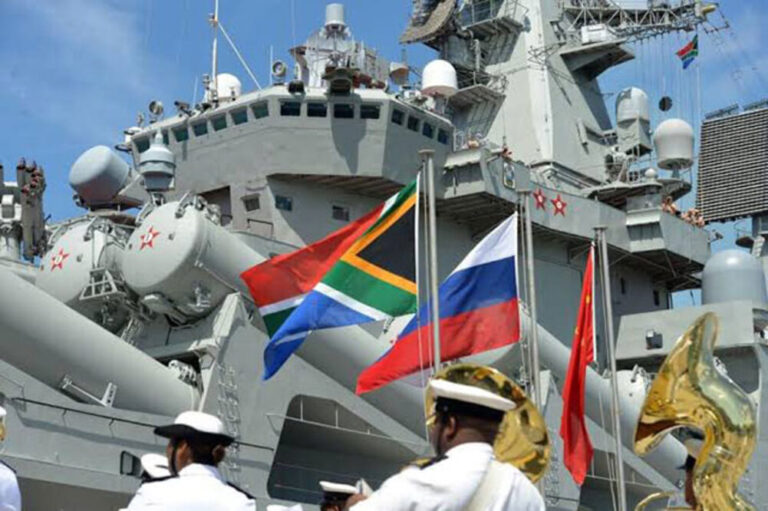
South Africa’s government is facing renewed scrutiny over its handling of last week’s multinational naval drills as officials pretended they were unaware of Iran’s participation despite clear evidence that an Iranian warship joined the at‑sea phase of the exercise.
The Ministry of Defence on Sunday announced that it was establishing a board of inquiry to determine why President Cyril Ramaphosa’s reported directive excluding Iran from Exercise Will for Peace 2026 “was not respected.”
The move has raised questions about whether Pretoria is attempting to distance itself from a politically sensitive episode rather than uncovering what actually transpired.
The controversy comes at a delicate moment in South Africa’s relations with the United States, which has repeatedly warned partners against deepening military cooperation with Iran.
Washington has previously expressed concern over Pretoria’s growing defence ties with countries under US sanctions, including Iran and Russia.
The presence of an Iranian vessel in the drills is likely to sharpen those tensions.
Despite an earlier South African statement suggesting Iran had withdrawn, the Iranian Navy corvette IRINS Naghdi (F82) sailed from Simon’s Town Naval Base on 13 January alongside Russian, Chinese, Emirati and South African ships for the two‑day sea phase.
Iran’s state broadcaster Press TV celebrated the deployment, claiming the exercise included a live‑fire component.
Other Iranian vessels – the IRINS Makran, the IRIS Shahid Mahdavi and China’s CNS Taihu – remained docked and did not take part in manoeuvres.
South African officials have since implied that the Naghdi may have merely “observed” the drills, a characterisation at odds with Iran’s own public statements.
Further complicating Pretoria’s position, South African Navy chief Monde Lobese was photographed on 16 January visiting all three Iranian ships and meeting the commander of Iran’s 103rd Flotilla, Emad Nejad Moridi.
Iranian media reported that both sides agreed to deepen maritime cooperation – a message unlikely to reassure US officials already wary of Iran’s expanding naval diplomacy.
Analysts say the board of inquiry may ultimately provide political cover rather than accountability, with expectations that it will conclude Iran did not formally participate.
JN/APA