





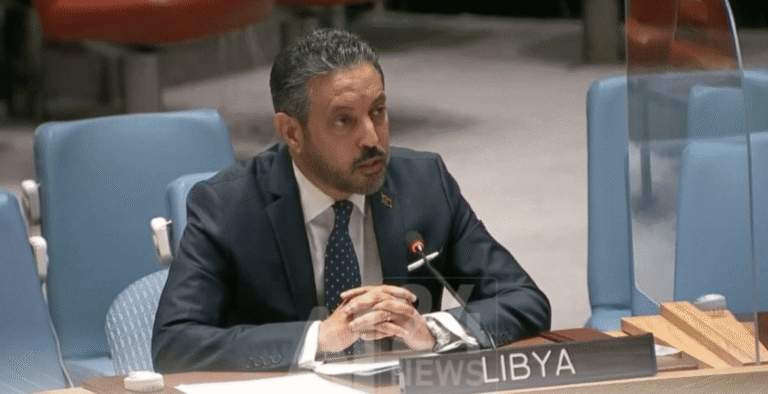
Libya’s Permanent Representative to the United Nations, Taher El-Sonni, addressed the UN Security Council, asserting that the numerous crimes and atrocities committed in Libya stem directly from the absence of a comprehensive political solution and nearly 15 years of persistent negative foreign intervention.
During the session devoted to the report of the Prosecutor of the International Criminal Court (ICC), El-Sonni stressed that Libya does not intend to remain indefinitely on the ICC agenda or under Chapter VII of the UN Security Council.
El-Sonni emphasized that the Government of National Accord considers the rights of Libyan victims an absolute priority. He insisted that the ICC’s mandate must be based on the principle of complementarity rather than substitution, meaning national courts must remain the primary competent authority for judicial action.
He cited the mass graves of Tarhuna as the “crime of the century,” demanding effective coordination between national and international justice mechanisms to prosecute those responsible.
El-Sonni provided detailed updates on the progress made by the Libyan public prosecutor’s office: Tarhuna Investigations: The public prosecutor’s office has investigated 614 cases related to the crimes in Tarhuna, issued 255 judicial decisions, and referred 220 cases to the courts.
Detentions and Warrants: Fifty-two suspects are currently detained pending the outcome of investigations. Additionally, 111 arrest warrants have been issued for other suspects involved in murders, abductions, and enforced disappearances. Fugitive Perpetrators: El-Sonni confirmed that five wanted perpetrators, whose crimes constitute war crimes, have fled the country. He called on the ICC to intensify its efforts and coordinate with Libyan authorities to ensure their immediate arrest.
The envoy also revealed that 26 complaints have been filed against individuals involved in human trafficking and migrant smuggling, resulting in the arrest of dozens of foreign nationals.
In a direct message to the international body, El-Sonni urged the ICC to respect the principle of complementarity and improve its communication channels. He explicitly warned against any external pressure or politicization of the court’s work.
Finally, El-Sonni called on the international community to shift its focus toward supporting Libya’s national reconciliation efforts through transitional justice and the tireless search for truth.
MK/ak/ac/fss/abj/APA