





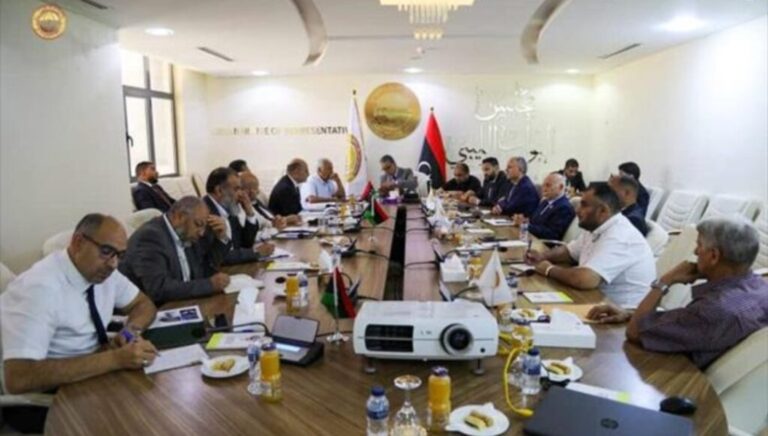
A tense meeting was held on Sunday in Tripoli to discuss the draft budget for 2025, highlighting the deep political and economic divisions plaguing Libya.
The session brought together the House of Representatives, the Central Bank of Libya (CBL), and the National Oil Corporation (NOC).
The proposed budget, totaling 160 billion Libyan dinars (nearly €30 billion), has faced significant criticism. House spokesman Abdullah Blihaq confirmed that the meeting focused on amending several of the bill’s provisions. The budget is already seven months late and has been called “not very transparent” by economic experts who point to its “contradictory figures.”
The CBL has consistently expressed concerns about the draft, arguing that it’s incomplete and needs further consultation. Governor Naji Issa has been working to find a compromise and has already agreed with House Speaker Aguila Saleh on three immediate reforms: increasing support for power plants, regulating bank lending, and improving oversight of public spending.
However, the NOC, which manages the country’s oil wealth, has also raised reservations, particularly regarding the allocation of funds for the energy sector. It argues that oil and electricity infrastructure require much more significant investment.
Beyond the technical details, the budget debate is a political power struggle between rival factions in Tripoli and Benghazi. The House of Representatives is trying to assert its control over public finances, while the CBL is fighting to maintain its central role in ensuring monetary stability and transparent financial flows. Governor Issa has publicly requested that the budget’s adoption be postponed in favor of a “more realistic” and amended text.
As Libya continues to face institutional deadlock and growing social needs, the final approval of the 2025 budget remains uncertain and dependent on a fragile political consensus.
MK/ac/fss/abj/APA