





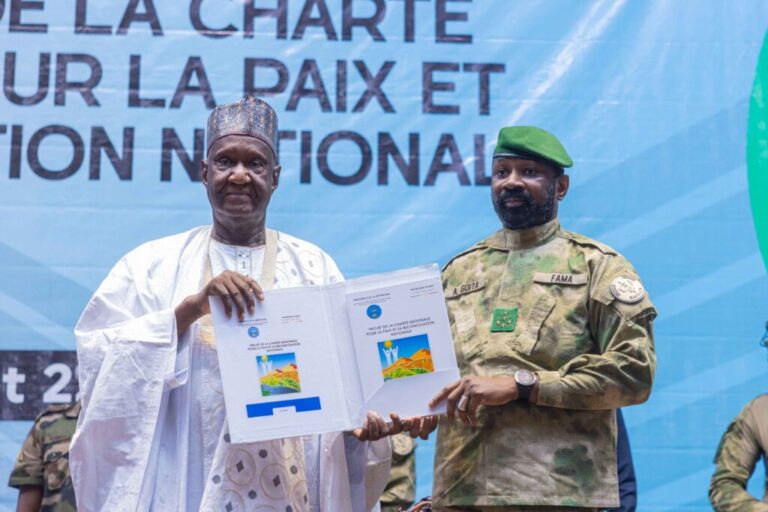
The Malian government officially endorsed a National Charter for Peace and Reconciliation on Wednesday, July 30, 2025.
This significant document, developed following the Inter-Malian Dialogue convened by the President of the Transition, General Assimi Goïta, aims to establish a new normative framework for peace, social cohesion, and governance across the country, rooted in Malian societal values and national sovereignty. Despite its adoption, the security situation remains volatile in the north and center of the country, where jihadist groups and the Azawad Liberation Front continue armed actions.
The Charter’s adoption by the Council of Ministers marks a pivotal step in Mali’s reconciliation efforts. This text, presented by the Minister of Reconciliation, Peace, and National Cohesion, comes after the Malian authorities denounced the Algiers Process Peace and Reconciliation Agreement in 2024, deeming it unsuitable for the national context. Subsequently, President Goïta initiated an Inter-Malian Peace Dialogue, held from February to May 2024, which recommended the drafting of this Charter. Its approval by the Council of Ministers now paves the way for its implementation.
The National Charter is intended as a foundational document for all initiatives promoting peace, reconciliation, security, coexistence, and the rebuilding of the state. Its preamble acknowledges the cyclical crises that have affected Mali since independence and expresses a collective desire to address them through a new social contract, firmly anchored in national values and the principles of sovereignty. The text articulates a strong political vision: “a sovereign, reconciled, tolerant, and peaceful nation, in a rebuilt state based on democratic, just, and equitable governance.” This guiding principle informs all chapters, from territorial governance and civic education to transitional justice, the fight against impunity, economic development, and collective security.
Anchored in Malian societal values
A distinguishing feature of the Charter is the emphasis placed on Malian societal values, which are established as pillars of public order. These include joking kinship, intergenerational solidarity, the notion of honor, forgiveness, humility, and the culture of dialogue. These symbolic benchmarks are presented as crucial tools for social regulation, complementing institutional mechanisms. The Charter recognizes endogenous and traditional methods of conflict resolution while reaffirming the central role of the justice system in resolving disputes. It calls for strengthening traditional legitimacy, local committees, cross-border cooperation, and the mobilization of active forces in a coordinated effort with state administration.
Operationally, the document identifies several key levers for implementation: restoration of state authority, equitable access to public services, securing sensitive areas, youth integration, community justice, and the fight against corruption. It also outlines mechanisms for dissemination, monitoring, and revision to ensure the document’s gradual adoption by public, private, and community stakeholders.
The Charter’s adoption occurs within a transitional context marked by a strategic refocusing on national sovereignty and sub-regional integration, particularly within the Confederation of Sahel States. It aims to lay the groundwork for a new governance framework that considers Mali’s specific characteristics and the imperative for lasting, internally driven peace.
However, the adoption of the Charter does not, at this stage, guarantee an immediate easing of the security situation. On the ground, non-state armed groups—notably the Azawad Liberation Front and various jihadist organizations affiliated with Al-Qaeda or the Islamic State—continue their operations in the northern and central regions, underscoring the persistent armed violence despite the political efforts undertaken by the transitional authorities.
MD/ac/Sf/fss/abj/APA