





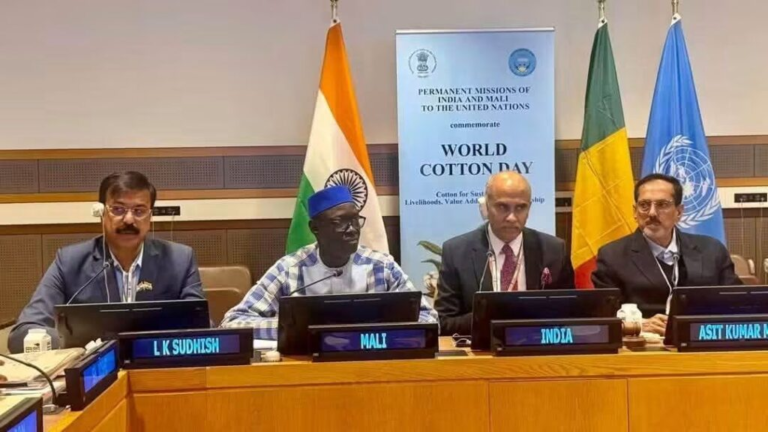
Mali is pursuing a strategic objective to process at least 10% of its national cotton lint production domestically, moving away from raw commodity exports to capture higher value within the domestic textile supply chain.
Addressing a UN side event organized jointly by the Malian and Indian missions in New York to observe World Cotton Day, Mali’s Permanent Representative to the United Nations, Issa Konfourou, called on international industrial partners and private investors to support local processing infrastructure and manufacturing capacity.
The initiative highlights a broader structural challenge across the Cotton-4 (C-4+) alliance—comprising Mali, Benin, Burkina Faso, Chad, and Côte d’Ivoire—where approximately 98% of regional cotton yield is currently exported in raw fiber form without domestic value addition. To address this deficit, the multilateral Cotton Partnership aims to mobilize $5 billion over the next decade to establish regional textile hubs and generate an estimated 500,000 jobs across C-4+ member nations. The push for local industrialization comes as the International Cotton Advisory Committee projects global cotton production to reach 25.9 million tonnes against 25.2 million tonnes in consumption for the 2026–2027 season, with international raw cotton trade expected to contract by 2.7% to 9.6 million tonnes.
MD/te/Sf/lb/abj/APA