





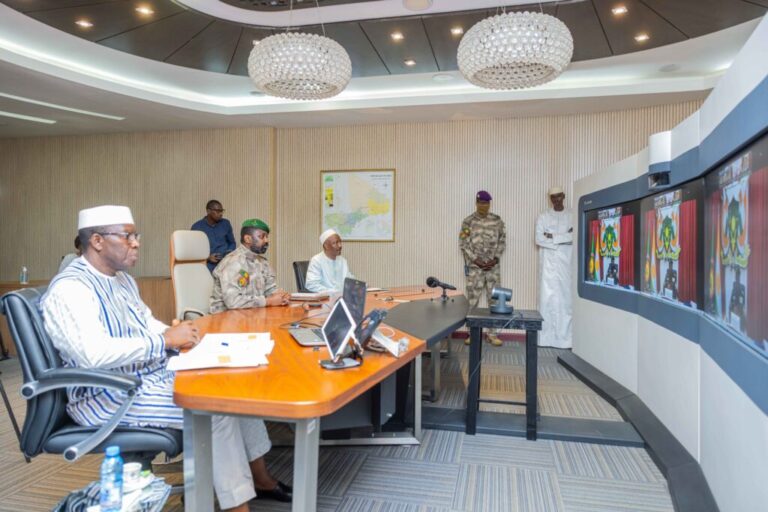
Meeting via videoconference on Friday, 11 July 2025, the leaders of Mali, Burkina Faso, and Niger agreed to transform the Liptako-Gourma Integrated Development Authority (ALG) into the implementing agency for the Confederation of Sahel States (AES).
The transition is to be completed by 31 December 2025.
The decision was made during the 8th Ordinary Session of the Conference of Heads of State and Government of the ALG, chaired by Niger’s head of state General Abdourahamane Tiani who is the current chair of the organisation.
He was joined by his counterparts from Mali, Assimi Goïta, and Burkina Fas’s, Ibrahim Traoré.
Strategic shift toward AES priorities
The session’s main objective was to align ALG’s mission with the broader goals of the AES. Several measures were adopted, including retaining ALG’s headquarters in Ouagadougou, the upcoming appointment of a provisional administrator, a full organisational audit, and the progressive transfer of competencies to the new agency.
A 50-year legacy: Achievements and challenges
Founded in 1970 and operational since 1973, the ALG was originally tasked with promoting integrated development in a 370,000 km² cross-border region plagued by insecurity and poverty.
Over the decades, it has implemented more than 230 development projects in key sectors such as water management, agriculture, road infrastructure, and community education. Between 2015 and 2021 alone, ALG mobilised nearly 65 billion CFA francs, primarily from international donors.
Notable accomplishments include 1,500 km of rural roads, the development of 12,000 hectares of land, the construction of 700 drinking water boreholes, and extensive capacity-building programs for thousands of local beneficiaries.
However, these achievements have been undermined by persistent security instability, limited internal funding, and coordination challenges with national policies.
Tight deadline, high stakes
The transformation of ALG into an AES agency presents serious hurdles. The tight timeline — less than six months — poses a major challenge to achieving comprehensive institutional reform. Additionally, ALG’s heavy reliance on external funding raises concerns about the long-term viability of the new entity, especially as the confederation seeks greater financial and political autonomy.
Without a clear strategic roadmap and reinforced resources, there is a risk that the new agency could become a purely administrative body with limited operational capacity.
President Assimi Goïta emphasised the importance of retaining ALG’s expertise while overhauling its structure to better serve the needs of AES and local populations. He advocated for streamlining existing institutions rather than creating costly new ones.
The heads of state tasked their ministers and technical experts with designing the agency’s future institutional framework in line with the confederation’s ambitions and realities on the ground.
This session marks another step toward deeper regional integration, rooted in shared sovereignty, solidarity, and locally driven development.
MD/te/lb/as/APA