



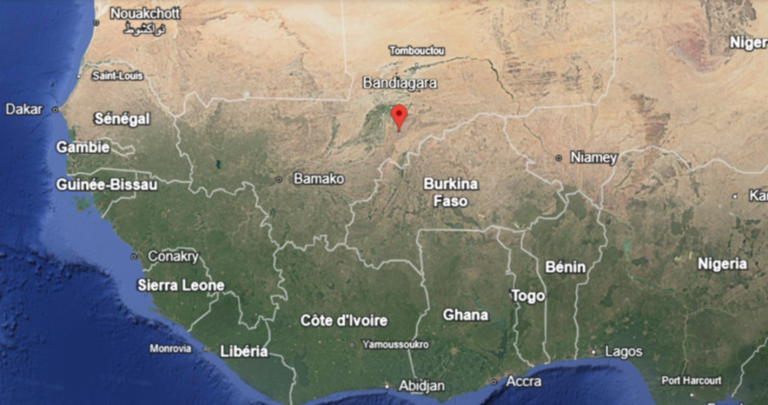
The Bandiagara region in central Mali is once again in mourning after simultaneous attacks on two villages.
Regional authorities are calling on the population to remain united alongside the Malian Armed Forces.
Two villages in the Bandiagara region of central Mali were attacked on 6 May by armed men amid widespread insecurity in this part of the country.
The attacks targeted Kori Kori, in the commune of Dugombo, Bandiagara district, and Gomossogou, in the commune of Lessagou, Diallassagou district.
The regional governor, Colonel-Major Olivier Diassana, denounced the “barbaric and cowardly” attacks carried out almost simultaneously against the two villages.
According to Diassana, this simultaneity demonstrates a prepared and coordinated action intended to undermine the morale of the population.
“These terrorist attacks targeted these two villages at the same time.”
“This proves the coordination and shows that these attacks were deliberately carried out to demoralize the people of the region who were beginning to truly believe in the possibility of peace,” the governor said in an address to the local population.
The official death toll has not yet been released in detail.
However, the governor spoke of “heavy losses on both sides” and several wounded.
Local reports suggest dozens of deaths, but no definitive figures have been published by regional authorities.
“It is with a heavy heart that I speak to you,” said Diassana, offering his condolences to the affected families.
The wounded have been evacuated to health centres in Bankass, Sévaré and Bandiagara where they are receiving treatment, according to authorities.
A joint mission from the administration and the defence and security forces has also been dispatched to the affected communities.
Its mission is to provide moral support to the families, assess immediate needs and assist in organising funerals.
The governor indicated that financial assistance had been allocated to support bereaved families.
He also announced that the regional reconciliation support team remained in contact with the victims’ relatives to listen to the families, ease tensions and prevent any
reactions that could worsen the situation.
In his address, the head of the regional executive called on residents not to give in to fear.
He asked traditional leaders, elected officials, civil administrators, community leaders and the entire population to remain mobilised alongside the Malian Armed Forces.
“We will not give up,” he insisted.
According to the governor, the situation is “under control,” and the Malian Armed Forces are continuing security operations in the region.
He indicated that the affected areas are receiving special attention.
The Bandiagara region is among the areas most exposed to violence in central Mali. For
several years, armed groups have been carrying out attacks against villages, security positions and roads.
Civilians are the first to be affected by this insecurity, suffering loss of life, displacement and difficulties accessing markets, fields, schools and health centres.
The attacks in Kori Kori and Gomossogou come as Malian authorities claim to be continuing their military operations in several regions of the country.
In the central region, security remains difficult due to the vastness of rural areas, the mobility of armed groups and the vulnerability of some isolated villages.
For the residents of Bandiagara, the immediate challenge is to cope with the grief, care for the wounded, and preserve local cohesion.
Regional authorities say they want to prevent these attacks from causing further fear or division in a region already marked by years of violence.
The governor called on the population to continue cooperating with the defence and security forces.
He also asked residents to remain vigilant and report any suspicious activity. In the affected villages, bereaved families are now awaiting increased protection and a more
sustained state presence.
The region, which had hoped for a gradual improvement in the security situation, is once again confronted with armed violence and its human consequences.
MD/ac/fss/jn/APA