





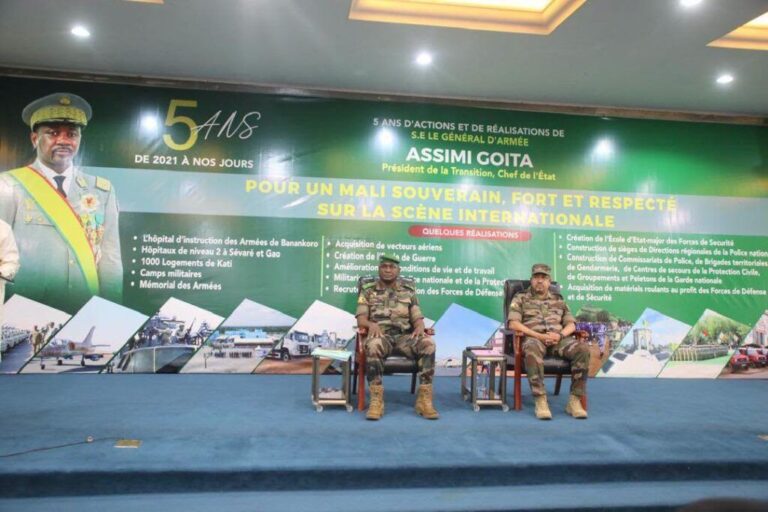
The Malian ministers responsible for defence and security presented the main achievements of their departments over the last five years.
They highlighted the investments made in favour of the defence and security forces.
The ministers delegated to the Malian Minister of Defense and Veterans Affairs, General Oumar Diarra, and of Security and Civil Protection, General Daoud Aly Mohammedine, presented on Monday the results of their departments during a citizen exchange organised at the Bamako
International Conference Centre (CICB), as part of the commemoration of the five years of governance of the head of the transition, Assimi Goïta.
According to the Malian government, this meeting brought together representatives of traditional authorities, the Network of Traditional Communicators (Recotrade), the Association of Veterans, Retired Soldiers, Widows and Victims of War, as well as the National Youth Council.
General Oumar Diarra highlighted the investments made in the defence sector, citing in particular the construction of the Banankoro army training hospital, the military camps of Dioila and Konobougou, the level 2 military hospitals of Seware and Gao, as well as 1,000 housing units intended for the military in Kati. He also discussed the creation of the War School, the construction of the Army Memorial, the acquisition of new air vectors and the improvement of the living and
working conditions of the Malian Armed Forces.
General Daoud Aly Mohammedine indicated that the Ministry of Security and Civil Protection had completed 131 infrastructures in five years for the benefit of the national police, the national gendarmerie, the national guard and civil protection unit. He also reported the acquisition of important law enforcement equipment, weapons, intervention vehicles, ambulances, troop transport trucks, patrol motorcycles and relief equipment.
The minister specified that more than 15,000 agents had been recruited within the national police and civil protection during this period, while 3,000 others are currently undergoing training.
He also highlighted the militarisation of these two bodies, which occurred with the law of October 2022, as well as the circulation of the biometric passport and the national biometric identity card of the Confederation of Sahel States (AES).
Addressing regional cooperation, the minister stressed that Mali now favours the framework of the Confederation of Sahel States, while remaining open to partnerships based on respect for its sovereignty.
Discussions with participants mainly focused on the progress of the new military camps, recruitment within the defence and security forces, social housing for the military, the role of youth in the security effort and the contribution of citizens to intelligence.
According to the official report, the public’s interventions mainly welcomed the efforts made by the authorities in terms of recruiting, equipping, training and improving the working conditions of the
defence and security forces.
In conclusion, the two ministers called on the population to continue their collaboration with the defence and security forces, by demonstrating vigilance and transmitting any useful information to the competent authorities.
MD/ac/Sf/fss/as/APA