





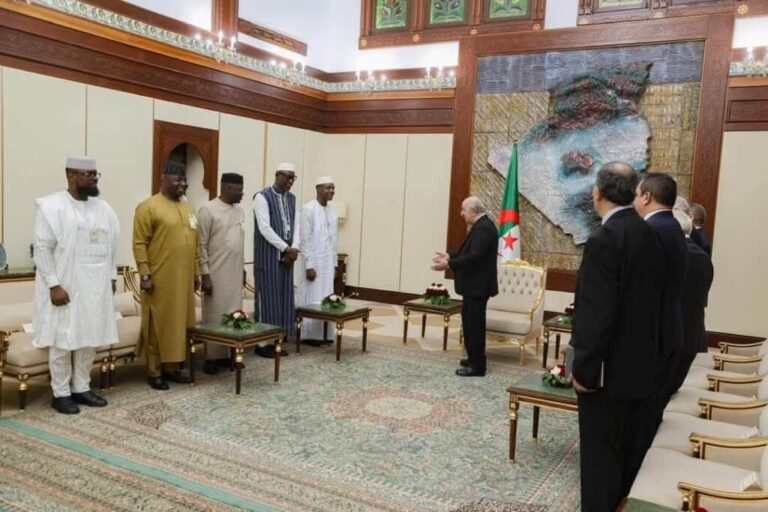
Mali’s head of political transition Assimi Goita has accepted the invitation from his counterpart, Abdelmadjid Tebboune, to pay an official visit to Algeria as relations between the two neighbours somewhat improve.
While no specific date has been announced, this meeting will elevate to the presidential level the rapprochement initiated in July after fifteen months of diplomatic crisis.
General Assimi Goita, agreed to make an official visit to Algeria, according to Prime Minister Abdoulaye Maïga following a meeting with President Abdelmadjid Tebboune.
The Malian PM delivered a message from Assimi Goita to his Algerian counterpart. In this letter, the Malian leader thanked Tebboune for his invitation, which he considered “a mark of affection and consideration” towards him and the Malian people.
“He agreed to make this official visit to Algiers,” said Abdoulaye Maiga, specifying that the dates would be agreed upon through the usual diplomatic channels.
No timetable, sectoral agreement, or new bilateral mechanism was announced following the trip.
Rapprochement at the top
The acceptance of this invitation constitutes the main political outcome of Abdoulaye Maiga’s visit. It paves the way for a direct meeting between the two heads of state, following the restoration of
diplomatic channels on July 10.
Both countries had then announced the return of their ambassadors and the reopening of their respective airspaces.
These measures lifted the main restrictions imposed after the destruction, on the night of March 31 to April 1, 2025, of a Malian drone near their shared border.
Algiers had claimed that the aircraft had entered its airspace. Bamako rejected this version and
denounced it as a hostile act. Mali, Burkina Faso, and Niger subsequently recalled their ambassadors from Algeria, before Algiers retaliated by closing their airspace.
However, tensions predated this incident. In December 2023, Bamako criticised Algiers for its contacts with leaders of former armed groups in the north and for hosting Imam Mahmoud Dicko.
In January 2024, the Malian government withdrew from the peace and reconciliation agreement stemming from the Algiers process, citing acts of hostility and interference attributed to the Algerian side.
In Algiers, Abdoulaye Maiga emphasized the enduring nature of the neighbourly relationship between the two countries, which share a common border of more than 1,300 kilometres.
Echoing President Tebboune’s statement that neither could “move away,” he asserted that Mali and
Algeria were “destined to walk together” and work for the prosperity of their people. The PM also reported that the Algerian President had reaffirmed the principle of non-interference in the internal affairs of neighbouring countries.
This assurance addresses one of the main grievances that fuelled the crisis between Bamako and
Algiers.
A relationship to be redefined
Geographical proximity is accompanied by a long history of Algerian mediation in the crises of northern Mali. Algiers notably hosted or led the processes that resulted in the Tamanrasset Accords in 1991, the Algiers Agreement of 2006, and then the Agreement for Peace and Reconciliation of 2015.
This history explains Algeria’s particular weight in the Malian situation, without granting it an automatic mandate in the new regional context.
The rapprochement therefore does not signify a return to the previous arrangement. No statement has mentioned a reactivation of the 2015 agreement or the reinstatement of the mediating role formerly held by Algiers.
At this stage, both capitals seem to favour a relationship directly managed by the states and based on respect for their sovereignty.
Another fundamental disagreement remains in the background. On April 10, 2026, Mali withdrew the recognition it had granted since 1980 to the Sahrawi Arab Democratic Republic and expressed its support for Morocco’s autonomy plan under Moroccan sovereignty. This stance, reaffirmed in July, contrasts with that of Algeria, which supports the Polisario Front and the Sahrawi people’s right to self-determination.
Western Sahara remains listed by the United Nations as a non-self-governing territory, pending a political settlement of its status.
This issue was not publicly raised during the hearing on August 24.
The continued rapprochement nevertheless demonstrates that the two neighbours have chosen to resume dialogue without making it contingent on prior alignment on all regional issues.
Abdoulaye Maiga also placed this dynamic within the framework of the Confederation of Sahel States. According to him, the vision based on sovereignty, non-interference, and the fight against terrorism is also shared by Niger’s President Abdourahamane Tiani and Burkina Faso’s President Ibrahim Traore.
Assimi Goita’s upcoming visit should allow for an assessment of whether this détente can lead to concrete mechanisms for political consultation, border security, movement, and economic cooperation.
The scheduling of his visit will be the next indicator of the strength of the rapprochement between Bamako and Algiers.
MD/ac/fss/as/APA