





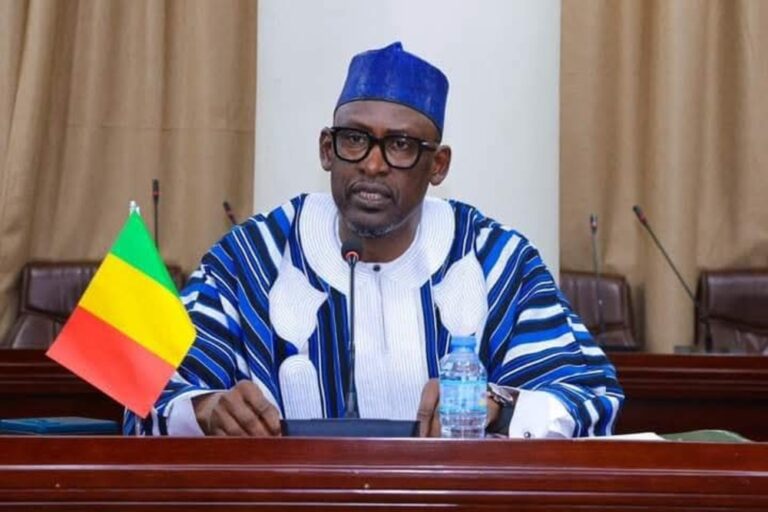
Comments made by Mali’s Foreign Minister Abdoulaye Diop at the Lomé Peace and Security Forum have stirred widespread debate back home, after his reference to the country’s first president, Modibo Keïta, sparked controversy and prompted clarification.
Speaking in Lomé alongside his Burkinabè and Nigerien counterparts, Diop cited Modibo Keïta as an example to illustrate the leadership challenges African nations faced at the dawn of independence. According to excerpts widely shared on social media, the minister said that “Modibo Keïta was a schoolteacher” and that he “was not prepared to lead a country,” before adding that today’s leaders possess different kinds of experience and skills.
Those remarks were swiftly interpreted by many as a slight against the legacy of Mali’s founding president, prompting a wave of criticism online.
Within hours, social media in Mali was flooded with criticism. Many users, political figures, and associations dedicated to preserving Modibo Keïta’s memory denounced what they viewed as an affront to the father of the nation’s legacy. Several voices called for respect toward his memory, recalling his pivotal role in leading Mali to independence on September 22, 1960.
The backlash extended beyond political circles. Historians and educators pointed out that while Modibo Keïta did begin his career as a teacher, he also held key political positions before 1960, including as a member of the French National Assembly, Secretary of State under France’s Fourth Republic, and head of government of the short-lived Mali Federation. They argued that these experiences contradict the notion that he was unprepared to govern.
Amid the growing controversy, Abdoulaye Diop issued a statement on his official social media accounts expressing his “deep respect” for Modibo Keïta, whom he described as “an emblematic figure of our independence and a model of integrity, patriotism, and foresight.”
He clarified that his intention was “never to diminish [Keïta’s] legacy,” but rather “to highlight the model of achievement he represents in the context of Africa’s contemporary leadership challenges.” Diop concluded by reaffirming that Modibo Keïta remains for him “a constant source of inspiration in defending Mali’s sovereignty and dignity.”
The controversy comes just weeks after the 65th anniversary of Mali’s independence, marked by several official tributes to Modibo Keïta. The commemorative timing amplified the emotional impact of the incident. National media commentators have since emphasised Keïta’s central place in Mali’s historical memory and his enduring defense of sovereignty, unity, and dignity.
The Ministry of Foreign Affairs has not issued any further statements, and no official measures have been announced in connection with the controversy. However, several public figures have called for greater caution in comments made abroad, especially when referring to historical national figures.
Born in 1915 and passing away in 1977, Modibo Keïta remains a towering figure in Mali’s political history. Founder of the Sudanese Union–African Democratic Rally (US-RDA), he led the nation to independence in 1960 and pursued a socialist-oriented policy before being overthrown in a 1968 military coup. His legacy continues to symbolise Malian nationalism and the quest for African unity.
MD/ac/sf/lb/as/APA