





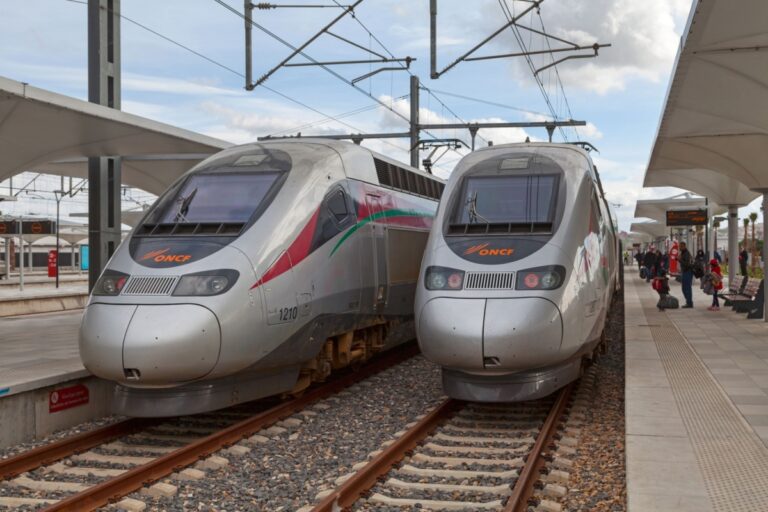
King Mohammed VI on Wednesday inaugurated in Casablanca a vast regional railway program worth 20 billion dirhams (about €1.8 billion), designed to overhaul mobility across the metropolis and its wider urban area.
Part of a nationwide scheme totaling 96 billion dirhams (€8.6 billion), the initiative reflects the monarch’s determination to anchor Morocco in a model of sustainable, integrated transport. It builds on the momentum created by the April launch of the 430-km Kenitra–Marrakech high-speed rail line, the backbone of the country’s future rail network.
The new project includes the construction of three major multimodal stations: Casablanca-South, in the Hay Hassani district; the station at the Grand Stade Hassan II in Benslimane; and Mohammed V Airport station. Equipped with state-of-the-art facilities and designed to handle up to 12 million passengers annually, these hubs aim to streamline connections with high-speed trains, regional lines, and urban transport (tram, bus, taxis).
The Casablanca-South station, where works have just begun, alone represents an investment of 700 million dirhams (€63 million). It will serve as a benchmark intermodal hub with direct access to the planned “Aero-Express” train linking Casa-Port and Mohammed V Airport every 15 minutes.
The plan also calls for 10 new suburban train stations and upgrades to five existing ones. Three lines totaling 92 km will be developed, offering high-frequency services with trains running every 7.5 minutes and carrying up to 150,000 passengers daily.
An additional investment of 625 million dirhams (€56 million) covers two new maintenance centers in Zenata and Nouaceur, five service depots, and 260 km of new track.
To support this expansion, Morocco will acquire 48 automated trainsets, each with a capacity of 1,000 passengers and capable of speeds up to 160 km/h, from South Korean manufacturer Hyundai Rotem, at a cost of 7 billion dirhams (€630 million). A production plant will be established in Morocco to foster a national rail industry with medium-term export potential.
Funded 70 percent by the National Railways Office (ONCF) and 30 percent by the Casablanca-Settat Regional Council, the projects are expected to create thousands of direct and indirect jobs, improve urban quality of life, and cut CO₂ emissions through low-carbon mass transit solutions.
Beyond Casablanca, the program underscores Morocco’s integrated approach to sustainable mobility and territorial connectivity, with a strategic horizon set for 2030.
MK/ac/sf/lb/as/APA