





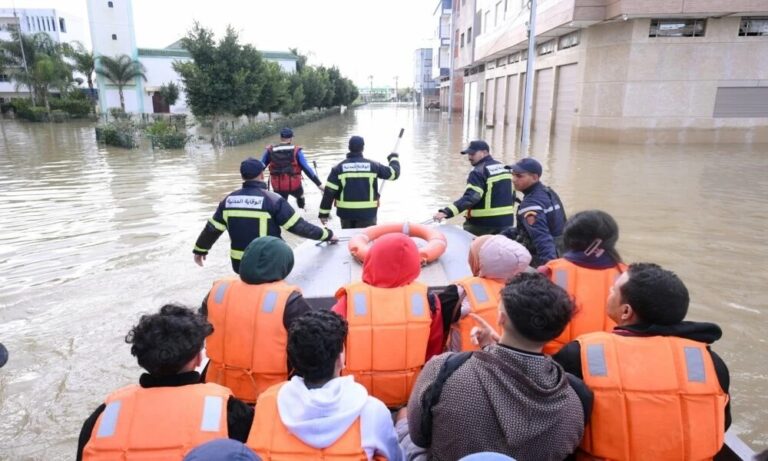
Morocco has entered a state of total mobilisation as authorities provide proactive, continuous monitoring of an exceptional weather crisis caused by severe storms and heavy flooding currently battering several regions in the north of the kingdom.
According to the Moroccan Ministry of the Interior, public authorities have spent the past several days engaged in a coordinated, multi-departmental effort to manage this unprecedented situation. To date, 108,423 people have been evacuated and relocated across several provinces, with the city of Ksar El Kebir being the most heavily affected.
In a press statement delivered on Wednesday in Rabat, Interior Ministry spokesperson Rachid El Khalfi stated that a preventive approach was implemented to safeguard lives and property before risks intensified. This follows a significant rise in the water levels of major rivers and waterways.
Acting on instructions from King Mohammed VI, the operation has seen an intensive field mobilisation. Units of the Royal Armed Forces (FAR) have been deployed in coordination with the interior ministry and other agencies to oversee the evacuation and transport of citizens, ensuring the operations proceed smoothly with the necessary logistical and human resources.
“In the interest of public safety, residents of several communes have been progressively evacuated,” El Khalfi confirmed. “This approach accounts for risk levels and potential damage, while providing transportation for those affected.”
Breakdown of Evacuations
According to the official, the evacuation of 108,423 individuals includes: Ksar El Kebir: 81,709 people (where 85% of the population has either been evacuated or left by their own means), Sidi Kacem Province: 9,728 people, Sidi Slimane: 2,853 people, Kenitra: 14,133 people.
El Khalfi noted that these preventive measures have been instrumental in mitigating the impact of the crisis.
Competent services continue to support affected populations by establishing emergency shelters and reception centers to provide essential aid and maintain public security.
The authorities are bracing for further meteorological disruptions in the coming days. Weather alerts predict rainfall could reach 150 mm in a short period in certain regions, leading to unprecedented water inflows—particularly at the Oued El Makhazine dam. Current hydrological data indicates a record-breaking rise in the dam’s reservoir, which is placing significant pressure on its infrastructure.
Consequently, the interior ministry has issued an urgent call for immediate evacuation for citizens in the following areas of Larache province: Ksar El Kebir, Souaken, and Oulad Ouchih, the Larache industrial zone and areas bordering the mouth of the Oued Loukkos.
“The situation demands a high level of vigilance and collective mobilisation,” the ministry stated, praising the local population for their cooperation and sense of responsibility.
Despite the record water levels, Salaheddine Dahbi, Director General of Hydraulics at the Ministry of Equipment and Water, assured the public on Wednesday that no structural malfunctions have been detected at the Oued El Makhazine dam.
He noted that the reservoir has exceeded its normal capacity since January 6, 2026, with water levels reaching four metres above the historical record set when the dam began operations in 1972. Notwithstanding these extreme conditions, the dam and its auxiliary equipment remain stable and under constant supervision.
AK/lb/as/APA