



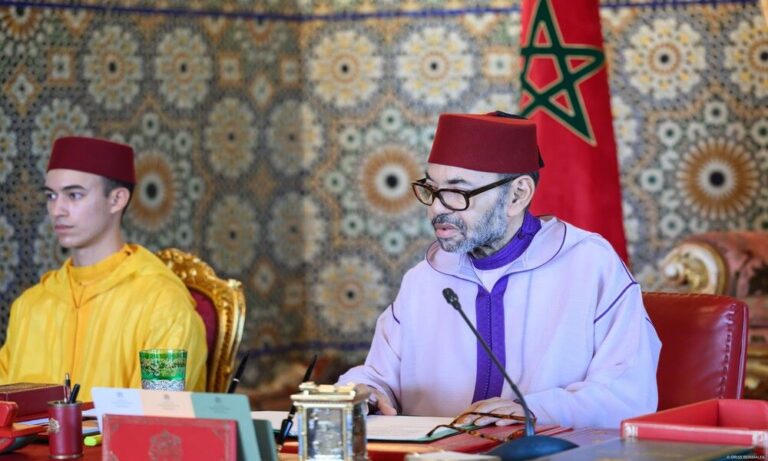
The Moroccan Council of Ministers meeting in Rabat on Saturday have approved the general guidelines of the 2027 draft Finance Bill.
The plan places young people, purchasing power and advanced regionalisation at the top of its priorities.
King Mohammed VI chaired the first Council of Ministers meeting at the Royal Palace in Rabat since the appointment of a new government led by Fatima Ezzahra El Mansouri.
The meeting focused on reviewing and approving the general guidelines of the draft Finance Bill for 2027.
At the start of the meeting, Economy, Finance and Public Sector Performance Minister Faouzi Lekjaa presented the main provisions of next year’s draft Finance Bill, according to a statement from the Royal Cabinet.
The proposed budget comes amid an international environment marked by the rising costs of geopolitical conflicts, expanding protectionist trends and intensifying competition in the energy, technology and financing sectors, the minister said.
Against this backdrop, Morocco’s economy is expected to grow by 4.7% by the end of 2026, while inflation is projected to remain around 0.7%.
The budget deficit is expected to fall to 3% of gross domestic product (GDP), he added.
The 2027 draft Finance Bill is built around five main priorities.
The first is to restore citizens’ purchasing power and strengthen the foundations of a sustainable welfare state. From 2027, the government plans to launch a structural reform of markets and pricing, alongside several measures to support household purchasing power.
El Mansouri’s government also intends to continue expanding universal health coverage and ensure the long-term sustainability of its schemes, while increasing the amount of direct social assistance.
This priority also calls for stepped-up efforts to improve public healthcare and education systems and expand access to decent housing through the implementation of the direct housing assistance programme.
The second priority is to integrate young people into education, training and decent employment.
The government plans to launch an integrated national programme covering 2027–2031.
It will focus on directing young people towards training and career support schemes, while facilitating their access to financing, guarantee mechanisms and markets.
The third priority is to accelerate the implementation of advanced regionalisation and a new generation of integrated territorial development programmes.
This approach calls for a clearer and more efficient allocation of responsibilities among regions, stronger coordination and contractual arrangements between the state and regional authorities, and the full implementation of the administrative deconcentration charter.
The government intends to speed up the rollout of this new generation of integrated territorial development programmes, backed by an estimated 25 billion dirhams in funding, the statement said.
The fourth priority is to strengthen Morocco’s strategic sovereignty in water, energy, food and digital technology. Planned measures include bolstering water security, accelerating the renewable energy development programme and continuing to implement Morocco’s green hydrogen offer.
They also include the gradual rollout of the roadmap for gas infrastructure, alongside measures to safeguard food security and strengthen the country’s digital sovereignty.
The fifth priority is to build a strong economy capable of financing the kingdom’s social ambitions and strategic sovereignty, while accelerating institutional reforms and preserving macroeconomic and financial stability.
Aimed at mobilising the funding needed to speed up major development projects and initiatives, as well as sectoral strategies across various fields, this priority also provides for the development of new sovereign industrial systems.
The 2027 draft Finance Bill also places particular emphasis on strengthening private investment. It provides for consolidating support mechanisms under the Investment Charter and continuing reforms of regional investment centres, with a particular focus on supporting very small, small and medium-sized enterprises.
King Mohammed VI appointed the new government, led by Fatima Ezzahra El Mansouri and comprising 32 members, on Friday.
El Mansouri is due to present the government programme on Monday, October 19, at a plenary session bringing together both chambers of parliament.
AK/lb/as/APA