



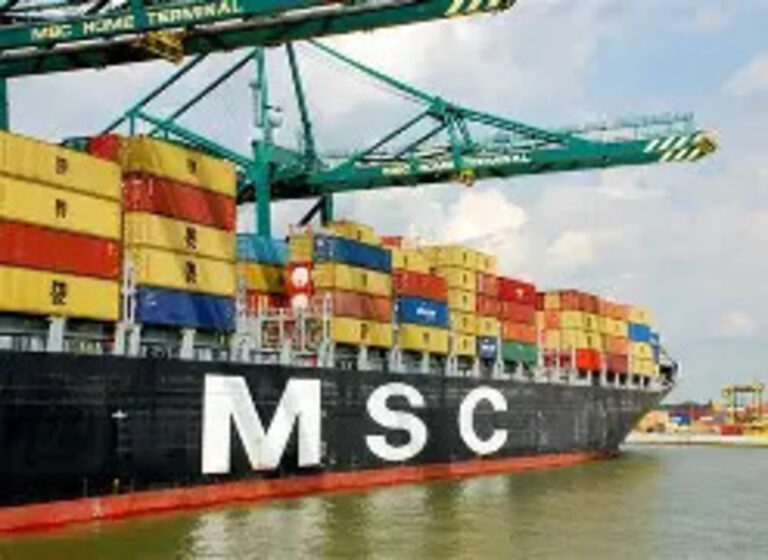
Global shipping company MSC has introduced emergency “war” surcharges on cargo bound for African countries and Indian Ocean islands after escalating security threats disrupted maritime traffic in the Straits of Hormuz and Bab El Mandeb.
MSC said the surcharges – effective from 5 March until further notice – followed “the evolving security situation in the Middle East,” which has affected vessel movements along two of the world’s most critical shipping chokepoints.
The Straits of Hormuz and Bab El Mandeb have seen repeated attacks and military confrontations linked to rising tensions involving Iran, Israel and the United States.
The disruptions have forced shipping lines to reroute vessels, increase insurance premiums and impose additional risk related charges.
“Consequently, MSC Mediterranean Shipping Company will implement an Emergency War Surcharge for all cargoes moving from the Indian Subcontinent (India, Pakistan, Sri Lanka, Bangladesh) to East Africa, Somalia, Mozambique and Indian Ocean islands,” the company said in a statement.
It added: “MSC Mediterranean Shipping Company will [also] implement a War Risk Surcharge (WAR) for all cargoes moving from the Arabian Peninsula (Bahrain, Iraq, Kuwait, Oman, Qatar, Saudi Arabia, UAE) to West Africa, East Africa, South Africa, Mozambique and the Indian Ocean Islands.”
Under the new measures, MSC will charge an Emergency War Surcharge of $500 per 20-foot equivalent unit (TEU) for dry containers and $1,000 per TEU for refrigerated containers from the Indian subcontinent to East Africa, Somalia, Mozambique and Indian Ocean islands.
It will also charge $2,000 for 20-foot containers, $3,000 for 40-foot containers and $4,000 for refrigerated containers on cargo from Gulf nations to countries in East, southern and West Africa.
The company said it is monitoring the situation and coordinating with authorities to ensure operational safety.
The Straits of Hormuz and Bab El Mandeb are vital maritime corridors linking the Middle East, Asia, Africa and Europe.
Hormuz handles a significant share of global oil shipments while Bab El Mandeb connects the Red Sea to the Gulf of Aden and the Indian Ocean.
Both waterways have become flashpoints amid escalating geopolitical tensions.
Attacks on commercial vessels, drone strikes and retaliatory military operations have forced shipping companies to slow down, divert routes or halt transits altogether – driving up global freight and insurance costs.
The surcharges come as several African countries are already grappling with rising fuel prices driven by global energy volatility.
In Nigeria, petrol prices surged this week, with motorists in Lagos paying up to ₦933 per litre and Abuja prices nearing ₦960, following adjustments by the Dangote Refinery and global market pressures.
The South African government announced fuel price hikes effective 4 March, citing higher shipping rates and geopolitical uncertainty. Petrol 93 rose by 20 cents per litre, while diesel increased by up to 65 cents.
The Zimbabwe Energy Regulatory Authority raised fuel prices sharply, with diesel now at US$1.77 per litre and petrol blend at US$1.71, up from around US$1.45 and US$1.47, respectively.
Economists warn that MSC’s surcharges will likely compound these pressures, increasing the cost of imported goods and straining already fragile consumer markets.
JN/APA