





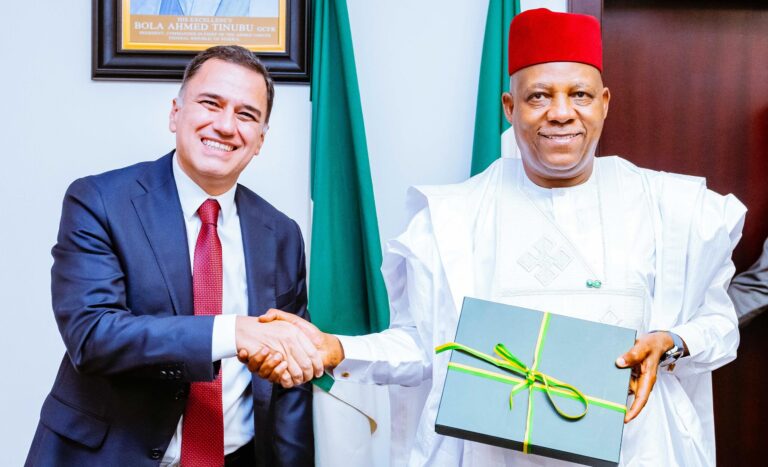
Nigeria and Brazil have signed the commercial phase of the 1.1 billion dollars Green Imperative Project (GIP) to boost productivity in agriculture and enhance private sector investment in Nigeria.
The GIP is the largest agricultural project in Africa which priotises the development of sustainable, low-carbon agriculture.
It aims to develop structural conditions to boost food production in Nigeria in an efficient and competitive manner.
Speaking during the signing of the commercial phase of the GIP 1, at the Presidential Villa, Abuja on Monday, Nigeria’s Vice-President Kashim Shettima said it was part of ongoing efforts of President Bola Tinubu’s administration to enhance food security.
Shettima said that the GIP would leverage on strategic opportunities to drive the nation’s economic growth and boost investors’ confidence.
“As this administration addresses the food security challenges, it is also delivering the 8-point agenda of President Bola Tinubu.
“It is imperative for us to synergise and use existing initiatives such as the GIP for the purposes of policy continuity, utilising or leveraging on strategic opportunities to drive our economic growth.
”This is with a view to enhancing investors’ confidence,” he said.
Shettima noted that while the GIP aligned with all the policies and programmes of the Tinubu’s administration, it would link small-scale farmers with all the agricultural value chains in the country.
”We have been battling with low agricultural productivity for decades, and as I have always said, entrepreneurial capitalism is embedded in the very psyche of the average Nigerian.
“This GIP is a wonderful opportunity because it seamlessly aligns with all the policies and programmes of this government.
“It’s a private sector driven initiative that targets the small-scale farmers and links them up with all the agricultural value chains,” Shettima said.
He commended the Ministers of Agriculture, Finance and Coordinating Minister of the Economy, Foreign Affairs, Justice and Attorney General of the Federation, among others, for the success of the project.
The Ambassador of Brazil to Nigeria, Carlos Garcete, said it was a great honour for Brazil to associate with the GIP.
”Over the past seven years, there has been negotiation with the Nigerian government to obtain the necessary funds from private and regional development banks to finance this ambitious project, which is worth approximately 1.1 billion dollars,” he said.
Garcete noted that the project would allow for the importation of agricultural equipment such as tractors, spare parts while assembling of the machines will be done in Nigeria with the Nigerian labour.
“In the event of breakdown of any tractor, it will be possible to carry out any repairs here in Nigeria by the personnel who will be trained by GIP,” he added.
In his remarks at the event, Nigeria’s Minister of Foreign Affairs, Ambassador Yusuf Tuggar, said that the agreement was a good example of the South-South Cooperation between Nigeria and Brazil.
He said both countries are very passionate about the project, considering what Brazil had achieved and how it turned a barren savannah into one of the prolific agriculture site in the world.
It will be recalled that the MoU for the $1.1 billion GIP 1 was signed in 2018,, while the $4.3 billion phase 2 of the project and the $2.5 billion JBS were signed in Brazil during President Bola Tinubu’s visit to Brazil in 2024.
GIK/APA