



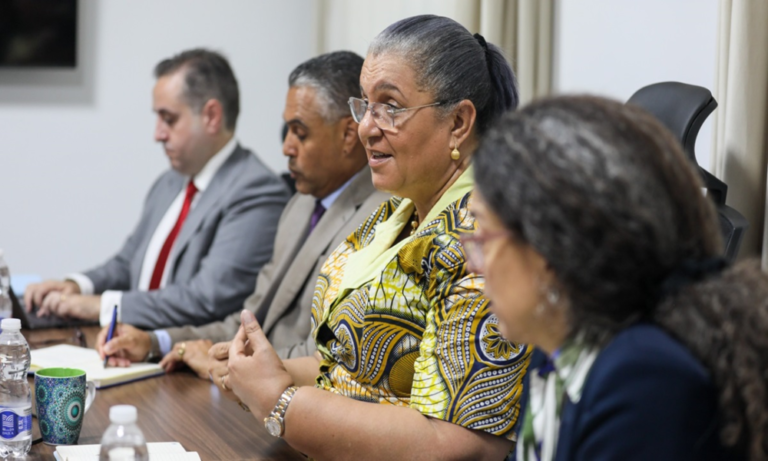
In her briefing to the UN Security Council on Friday, she emphasised that the implementation of the political roadmap presented last August continues to encounter strong internal resistance.
Ms. Tetteh noted that four months have passed since the official presentation of the roadmap on August 21, specifying that the United Nations Support Mission in Libya (UNSMIL) has since conducted intensive consultations with relevant Libyan stakeholders.
being paralysed by the inaction of certain actors, who are contributing, whether intentionally or not, to maintaining the status quo.
She indicated her readiness to explore an alternative mechanism, with the support of the UN Security Council, if the House of Representatives and the High Council of State in Libya fail to reach an agreement on the initial phases of the roadmap.
Ms. Tetteh explained that the structured dialogue initiated by UNSMIL aims to create a space for consultation on the implementation of the first two pillars of the political process and to establish a climate conducive to holding elections.
She announced that she would present the details of this mechanism at a press briefing scheduled for February.
Regarding institutional progress, she noted that the High Council of State had submitted nominations to the House of Representatives for the appointment of a chairperson for the High National Electoral Commission (HNEC), but no further significant progress had been made.
She also recalled the signing, on November 28, of a UN-brokered agreement to establish a mechanism for selecting members of the High National Elections Commission (HNEC), a timeline which, however, has not been met.
Ms. Tetteh concluded by urging the Libyan parties to intensify dialogue in order to reach a unified national budget and create the necessary conditions for holding credible elections, which she
described as crucial for Libya’s political future.
MK/ak/ac/Sf/fss/as/APA