






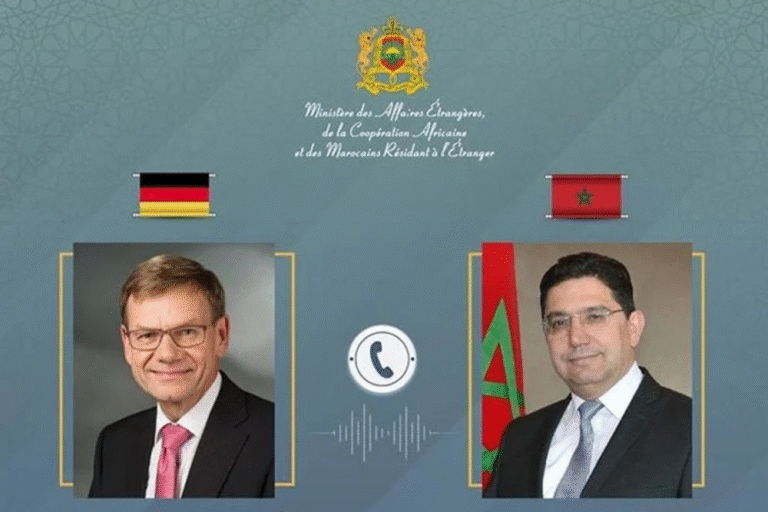
A series of technical and ministerial meetings between German and Moroccan officials has laid the groundwork for a renewed partnership focused on security, energy transition, and emerging technologies.
According to diplomatic sources, a new Moroccan-German cooperation framework is being finalised, aiming to elevate bilateral ties to the level of a “structuring strategic partnership.”
Since January 2025, both capitals have engaged in multiple high-level sectoral exchanges, deliberately avoiding grand declarations.
In the field of security, the interior and defense ministries of both countries are working to expand intelligence sharing on counter-terrorism, cyber-crime, and transnational trafficking. Joint training sessions for specialised units are in preparation, focusing on border surveillance, cybersecurity, and urban resilience.
On the energy front, Berlin has reaffirmed its support for Morocco’s decarbonisation strategy.
Germany is considering investment in several projects related to green hydrogen, electric interconnections, and smart grid management. A pilot project for green ammonia production and export to the Port of Hamburg is under review in the Guelmim-Oued Noun region, backed by a hybrid public-private funding model.
Technology cooperation is also a key pillar of this deepening alliance. Agreements are under discussion between GIZ (German Development Agency) and Moroccan universities to establish innovation hubs in AI, robotics for agriculture, and dual vocational training. Berlin sees Morocco as a reliable African partner for testing tech solutions adapted to the continent’s climate and social realities.
Beyond sectoral cooperation, this rapprochement reflects broader political alignment.
Germany publicly backs Morocco’s autonomy plan for the Western Sahara and regards Rabat as a stabilising force in the western Mediterranean. Several European diplomats have praised “Morocco’s ability to engage with all parties, even in complex crises such as those in the Sahel and Libya.”
The discretion surrounding this evolving relationship stems from a shared desire to avoid political exploitation. Nonetheless, the signals are clear: Berlin and Rabat are gradually building a long-term strategic partnership based on mutual trust, aligned transition models, and a commitment to pragmatic multilateralism.
MK/te/sf/lb/as/APA