





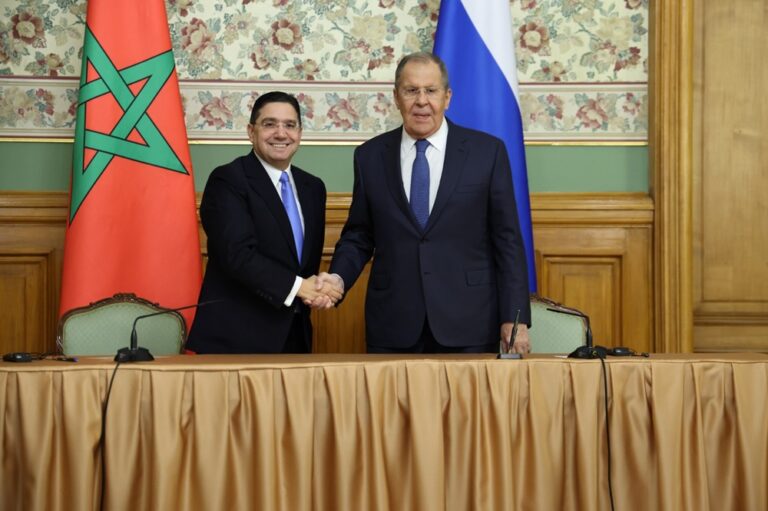
The issue of the Moroccan Sahara topped the agenda in Moscow during high-level talks on Thursday, October 16, between Moroccan Foreign Minister Nasser Bourita and his Russian counterpart, Sergei Lavrov.
The discussions affirmed a shared commitment between Rabat and Moscow that international legal principles should guide the path toward a solution without being used to obstruct progress.
“Morocco and Russia agree that international law and principles cannot be interpreted in a way that hinders progress towards a settlement of the Moroccan Sahara issue,” Minister Bourita stated at a press conference following the talks.
Bourita emphasized the need to acknowledge the current international momentum surrounding the issue, citing the efforts of King Mohammed VI and the changing positions of several key countries.
Bourita highlighted Russia’s importance as both a member of the Group of Friends and a permanent member of the UN Security Council, noting that Russia currently holds the Security Council’s rotating presidency for the month of October—a critical period when the body is scheduled to address the Western Sahara dispute.
“Russia is a key player in this issue,” Bourita said, stressing that dialogue between the two nations would continue in the coming days. Morocco views Russia as an active and important international actor whose engagement will yield positive results.
The Moroccan minister framed the engagement as constructive, stating, “This is a dialogue that is not against anyone, but rather a dialogue to strengthen regional peace and stability.”
Russian Foreign Minister Lavrov echoed this sentiment, affirming that both countries “share the position that these international principles must not be interpreted selectively… but must be applied and respected in their entirety and interdependence.”
To formalize their ongoing cooperation, the two foreign ministers signed a Memorandum of Understanding establishing a Russian-Moroccan Working Committee between their ministries. This new body will review their strategic partnership and formulate proposals to identify high-value cooperation areas for the future.
Minister Bourita’s visit to Moscow also included co-chairing the 8th session of the Moroccan-Russian Joint Cooperation Commission with Russian Deputy Prime Minister Dmitry Patrushev, focusing on expanding economic and technical ties.
Coming just before the Security Council meeting on the Sahara, Bourita’s visit strategically aims to ensure that Russia does not undermine the current international momentum supporting Morocco’s autonomy plan.
AK/ac/Sf/fss/abj/APA