



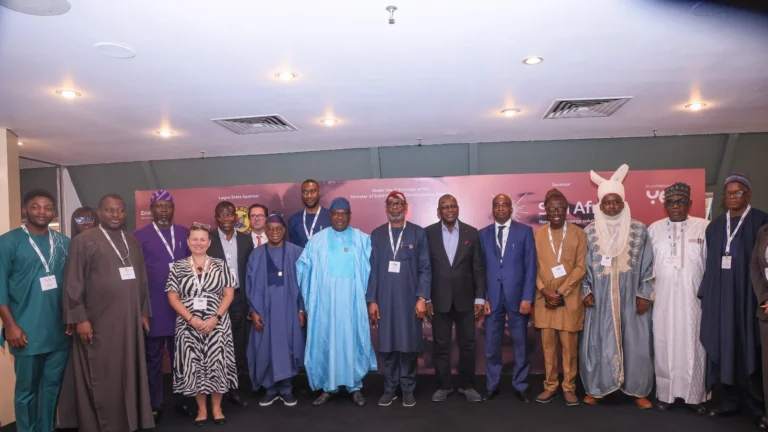
Nigerian President Bola Tinubu has tasked Ministries, Departments and Agencies (MDAs) on removing bureaucratic bottlenecks to ensure investment commitments translate into completed projects, jobs and economic benefits.
Declaring open the Nigeria NOW! Investing in Energy, Infrastructure and Mining Summit in Abuja on Thursday, Tinubu, who was represented by the Secretary to the Government of the Federation (SGF), Senator George Akume, said that Nigeria’s designation of 2026 as the Year of Delivery required government institutions to move beyond policy announcements and expressions of interest.
He said the focus must shift to actual investment decisions, construction and commissioning of projects.
“I expect public institutions to remove avoidable bottlenecks, coordinate across their mandates and work with investors in a predictable and timely manner.
“Our progress will be judged by functioning assets, expanding enterprises, decent jobs and stronger communities, not by the volume of promises made,” he said.
Tinubu acknowledged the sacrifices Nigerians had made amid the economic transition, stressing that reforms must deliver tangible opportunities and improved living conditions.
He described energy, infrastructure and mining as critical to Nigeria’s industrial transformation, requiring coordinated investments.
“Affordable and reliable power enables production, while transport and logistics connect producers to markets.
“Responsibly developed minerals provide raw materials for manufacturing, technology and emerging global supply chains.
“Investing across these sectors in a coordinated manner will lower costs, expand our productive base and strengthen Nigeria’s competitiveness,” he said.
Tinubu said the government would mobilise private capital for power generation, transmission, distribution and decentralised energy solutions.
He said that Nigeria would pursue a pragmatic energy pathway, harnessing its gas resources and renewable energy potential to provide reliable electricity.
“We welcome partnerships aligned with wider initiatives such as Mission 300, but the true test is whether more households and productive enterprises receive dependable electricity,” he said.
He identified transport corridors, ports, railways, roads and digital networks as priority investment areas for connecting economic centres.
He said such investments would also open underserved communities to economic opportunities.
Tinubu called for a shift from exporting unprocessed minerals to developing local beneficiation and processing industries.
He said improved geological information, transparent licensing and responsible exploration must be supported by increased investment in mineral processing.
The President explained that this would create skilled employment, strengthen Nigerian industries and deliver meaningful benefits to host communities.
He said that the government was committed to developing integrated value chains that would enable Nigerian businesses to participate actively in mining and other productive sectors.
Tinubu said the summit’s success would be measured by partnerships concluded, projects advanced and investments delivered.
In his remarks, Nigeria’s Minister of Solid Minerals Development, Mr. Dele Alake, expressed confidence that the summit would facilitate practical partnerships.
He said that it would also accelerate project delivery across the priority sectors.
Alake said that the solid minerals sector offered opportunities in exploration, extraction, mine development, processing and marketing.
He urged young Nigerians to acquire relevant skills to benefit from opportunities in the sector.
GIK/APA