



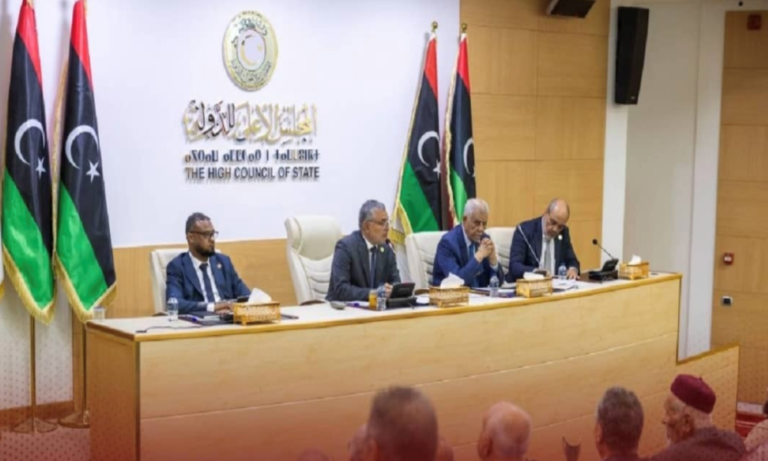
Libya’s High Council of State has reacted sharply to the recent activities of the United Nations Support Mission in Libya (UNSMIL), accusing it of exceeding its mandate.
The Mission is also criticised for allegedly undermining the institutional framework governing the political process in the country.
In a statement released on Saturday, the Libyan High Council of State announced the participation of two of its members, Ali Abdulaziz and Abduljalil Al-Shawsh, in meetings held in Rome.
According to the institution, these two individuals received no official mandate to represent the High Council, rendering any position taken at these meetings inconsistent with its official stance.
The statement reiterates that any external political participation must be validated in accordance with its internal regulations and decision-making mechanisms.
In its argument, the High Council of State cites its Decision No. 4 of 2026, which it considers binding, prohibiting any unauthorised involvement in internal or external political arrangements.
The High Council states that it informed the UN mission of this framework and believes that certain practices by UNSMIL in selecting interlocutors do not respect the principle of national ownership of the Libyan political process, as defined by the political agreement and the various roadmaps adopted during previous talks.
The High Council also criticizes what it considers a drift in the mission’s role, which has shifted from that of a facilitator to that of an actor influencing internal dynamics.
It believes this evolution contributes to exacerbating political divisions and slowing consensus-building efforts, particularly on sensitive institutional issues, including that of the High National Electoral Commission.
Regarding procedures, the institution recalls that an agreement had been reached between the committees of the High Council and the House of Representatives concerning this matter, in the presence of UNSMIL representatives.
It therefore considers that any parallel initiative outside these consensus frameworks undermines the agreements already established and calls into question their institutional coherence.
The High Council of State also rejects any initiative stemming from the Rome meetings, which it deems to lack a legal basis, and calls on its members to strictly adhere to the institution’s internal rules.
Finally, it invites UNSMIL to refocus its activities on a structured mediation role, in coordination with recognized institutions, in order to preserve existing dialogue mechanisms and prevent further
fragmentation of the Libyan political process.
MK/AK/Sf/fss/as/APA