





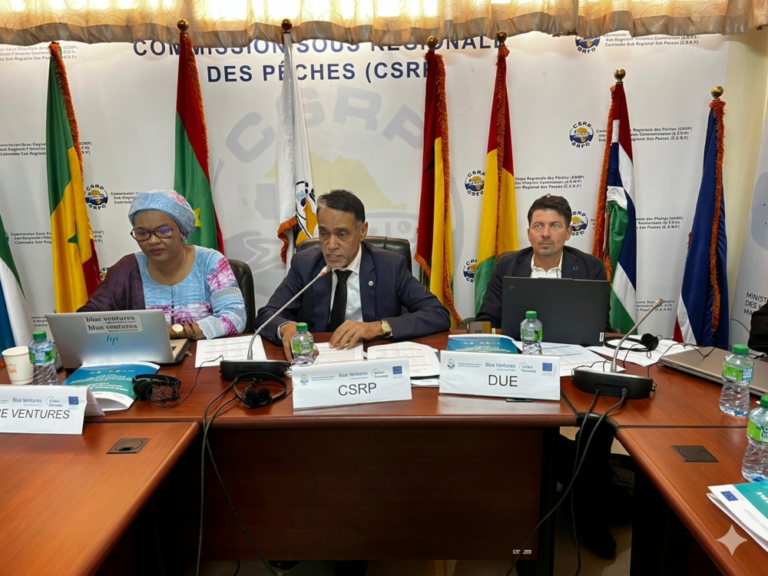
Faced with transnational challenges that threaten resources and livelihoods, public actors, professionals and partners are relying on a concerted approach to structure collective action, strengthen governance and sustainably embed the sector in dynamics of resilience and transparency.
“Artisanal fishing is the first line of defense against the precariousness of coastal communities,” Dr. Khallahi Brahim, Permanent Secretary of the Sub-Regional Fisheries Commission (SRFC), emphasized in his opening remarks.
However, this sector, essential to food security, employment, and social cohesion in the region, faces growing threats: overexploitation of resources, cross-border mobility of fishers, competition with industrial fishing, insecurity at sea, and illegal, unreported and unregulated (IUU) fishing.
“In the face of such threats, it would be illusory to think that strictly national responses would suffice,” he cautioned. It is in this context that a new regional governance mechanism for artisanal fisheries in West Africa was officially launched this Tuesday, under the auspices of the Sub-Regional Fisheries Commission (SRFC).
For three days, member states, professional organizations, and international partners will work together to develop an operational roadmap for the Artisanal Fisheries Technical Group (AFTG).
The European Union has announced a budget of nearly €60 million mobilized through several programmes to support sustainable, resilient, and equitable artisanal fisheries.
A significant portion will be dedicated to combating IUU fishing and providing direct support to artisanal fisheries.
The representative of the European delegation nevertheless cautioned:
“Money is not enough. It is your expertise, your commitment and your collaboration that will make the difference,” he emphasized. Artisanal fishers at the heart of decision-making
The West African Association for the Development of Artisanal Fisheries (EPA) welcomed an approach that fully integrates professionals in the sector. “Without the active and credible participation of artisanal fishing stakeholders, there can be no development,” declared its executive secretary, Moussa Mbengue, announcing the EPA’s full commitment to the work of the Working Group on Traditional Fisheries (WGAF).
The representative of the NGO Blue Ventures outlined four key areas for the group: alignment with the FAO’s Voluntary Guidelines at the regional level; the establishment of protected areas reserved for artisanal fishing to reduce conflicts over resource use; the strengthening of co-management and community participation; and improved transparency and access to data.
According to FAO figures, artisanal fishing provides essential micronutrients to more than 300 million people on the continent. She called for the harmonization of data collection systems, improved assessment of shared stocks, and enhanced participatory monitoring.
At the end of these three days, participants are expected to validate the WGAF’s terms of reference, establish its immediate priorities, and adopt its roadmap. The stakes extend beyond the CSRP zone: to make the group a model of participatory governance that can be exported to other regions.
“This group should allow us to bring together what, too often, operates in parallel: fisheries policies, science and the profession,” Mr. Brahim concluded.
ARD/te/fss/gik/APA